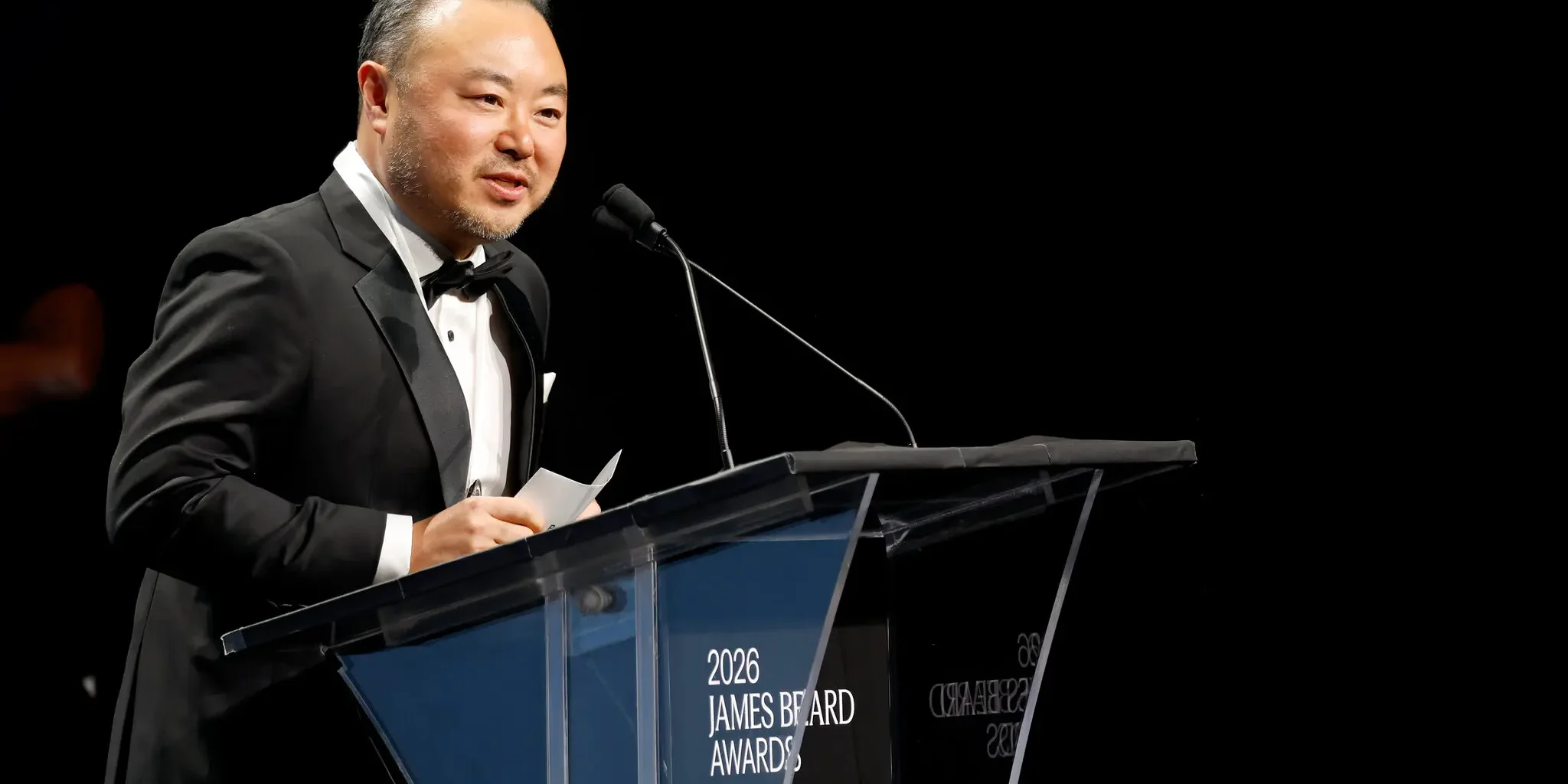
On June 15, Hooni Kim stood on the stage of the Lyric Opera of Chicago and accepted the James Beard Award for Best Chef: New York State. The recognition was, by most accounts, long overdue.
In 2012, his restaurant Danji became the first Korean restaurant anywhere in the world to receive a Michelin star. At the time, it stood alone. Today, New York City has twelve Michelin-starred Korean restaurants, among them a three-star and two two-star establishments. Kim did not just open a door; he opened a category. Earlier this year, the New York Times ranked Meju fourth on its list of the city’s 100 best restaurants. What is remarkable is that after more than a decade of firsts and accolades, he still spends his evenings behind an eight-seat counter in Long Island City, cooking dinner and talking to strangers about fermented soybeans.
The celebrity chef’s restaurant has become, in recent years, a genre defined largely by the celebrity chef’s absence: a name on a door, a concept handed to a proxy, a photograph on the menu that has not been in the building since opening week. Meju refuses this formula entirely. Kim is behind the counter every night the restaurant is open. He talks through each course, traces the lineage of each ingredient, explains why he grew this particular variety himself and why the industrial alternative is a nutritional capitulation. You leave having eaten extraordinarily well and having been genuinely taught something.
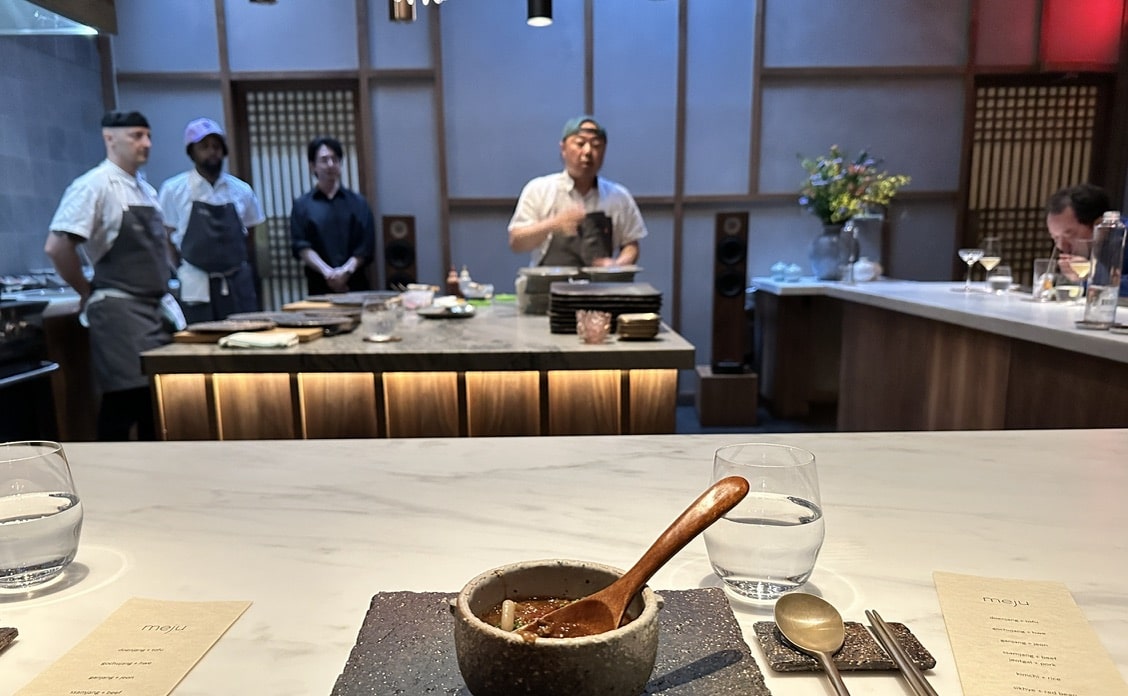 There is a moment, roughly midway through a meal at Meju, when the evening stops being dinner and becomes something harder to categorize. Kim is standing behind a white Italian marble counter, holding a small ceramic vessel, explaining what is inside it with the unhurried precision of a teacher who has thought about almost nothing else for a decade. The vessel contains a ganjang, a Korean soy sauce fermenting for well over a century. He passes it around. Eight people lean in. The room goes quiet.
Behind the Banchan Shop
Meju hides behind a banchan shop on 49th Avenue in Queens, and from the street nothing suggests what lies beyond it. You walk through Little Banchan Shop, past shelves of jarred ferments and housemade side dishes, and into a moody, high-ceilinged room that reads as both deeply Korean and entirely of the present moment. The marble counter runs the length of the space. The lighting is low without being theatrical. Eight seats face the kitchen, and the architecture of the room ensures that everyone eating is, in effect, having the same conversation.
Kim trained in kitchens like Masa and Daniel before opening Danji in 2011, which became the first Korean restaurant anywhere in the world to receive a Michelin star. He has since devoted himself entirely to Meju, and the decision tells you everything about where his thinking has arrived. As a young man he enrolled in medical school, drawn there partly by intellectual curiosity and partly by his mother’s wishes. He found hospital life suffocating, took a sabbatical that became permanent, and enrolled instead at the French Culinary Institute. The medical training was not wasted. It surfaces constantly at the counter, where the chemistry of fermentation and the biology of the gut microbiome are not abstractions but the organizing logic of every dish he serves.
The Mother Sauces of Korea
The restaurant’s name signals its intent. Meju refers to the dried soybean blocks from which wild fermentation begins, before the soybeans are transformed into the jangs that form the flavor foundation of Korean cuisine. Doenjang, gochujang, ganjang: these are the mother sauces of Korea, as Kim puts it, and they arrive early and often throughout the meal, each revealing a different register of depth, funk, or heat depending on the age of the ferment. Mass-produced versions of these pastes, he explains, yield weakened probiotics that are nearly meaningless to cook with.
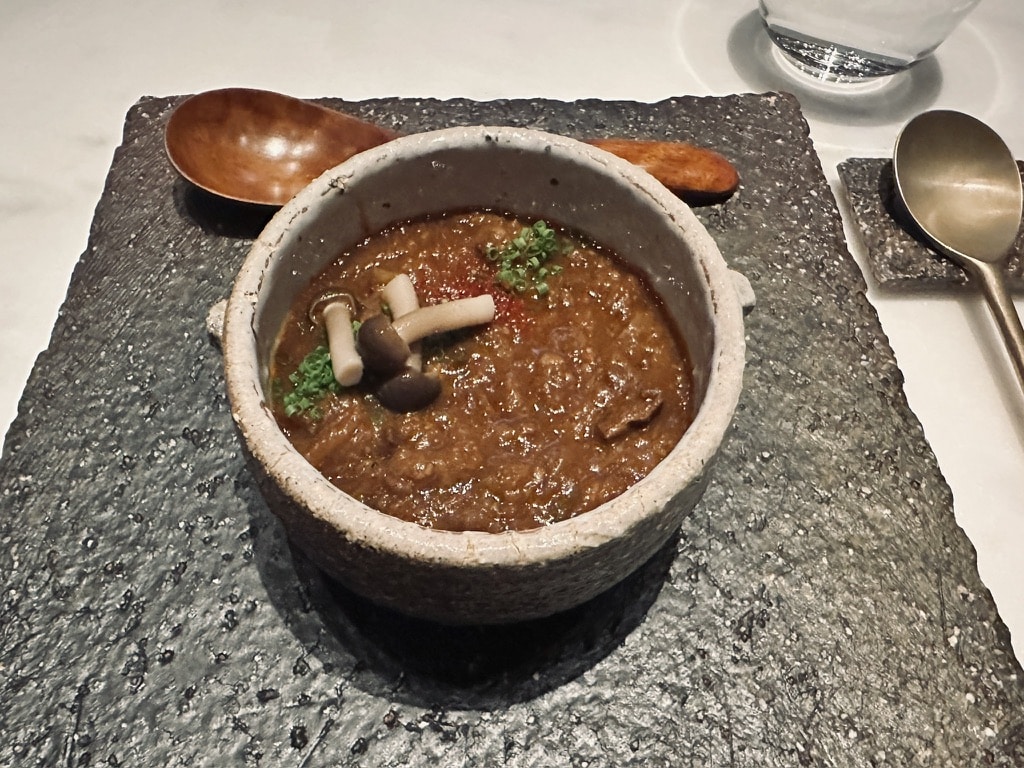 His jangs are wild-fermented, made by hand over years, some sourced from trusted producers and some developed through his own practice, which he has been building for more than a decade. A portion of his ingredients come from a farm on Jeju Island, the volcanic southern island whose mineral-rich soil and temperate climate produce ingredients of uncommon intensity.
Food as Medicine
The rationale behind all of this is not merely culinary. Kim holds that traditional Korean cuisine is rooted in health, in the use of clean ingredients as medicine, and that his obligation as a cook is to the wellbeing of the people sitting in front of him. Korea’s mountainous terrain historically meant harsh winters, scarce resources, and a cuisine that could not afford waste. Fermentation became the technology of survival: a method of preservation, but also of transformation, one that broke down proteins and starches into forms the body could absorb with maximum efficiency. The microbiome science now filling magazine pages has a centuries-old precedent in the Korean kitchen, and Kim is its most compelling voice in New York.
The Dishes
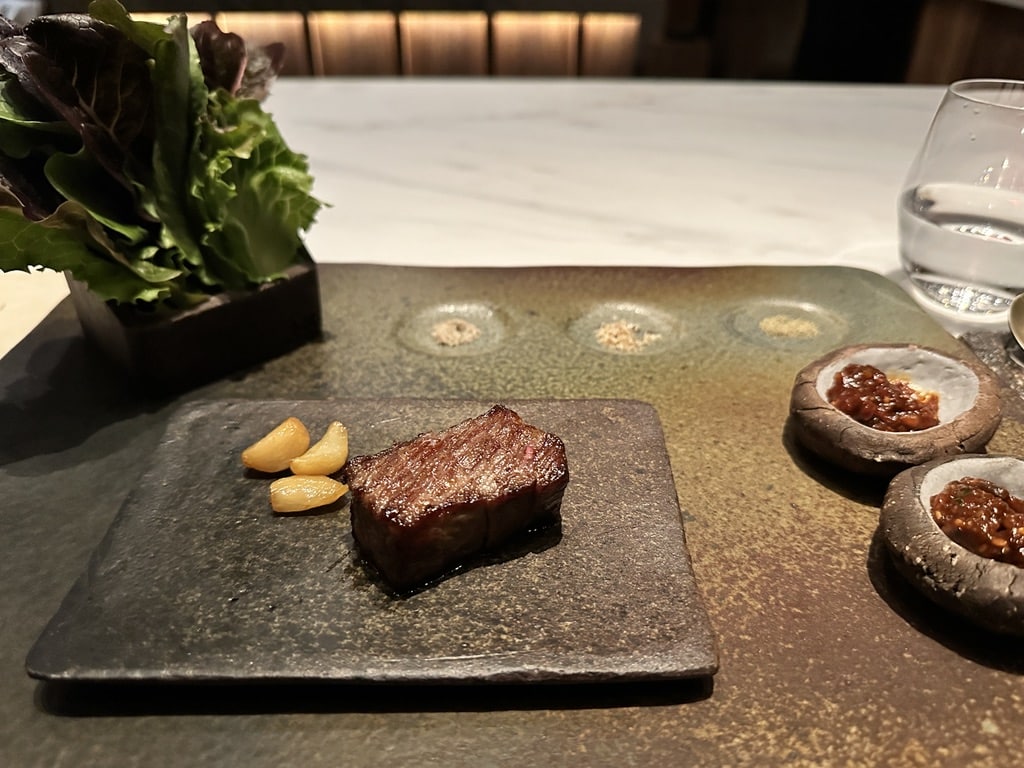
The food is strikingly minimalist in presentation, the ingredients exceptional. Silky tofu, fried pancakes, Miyazaki beef, Niman Ranch pork: each course arrives calibrated so that the fermented jangs function simultaneously as seasoning, glaze, and main event. The ceramics are handmade from Korean clay, designed by Kim, and their rough irregular surfaces feel like an extension of the fermentation philosophy. Nothing industrialized, nothing interchangeable.
 The meal ends with a bowl of rice and kimchi that is, for all its apparent simplicity, the course that lingers longest. It is an homage to the Korean mothers who, through generations of war and displacement, kept the deep traditions of Korean cooking alive when nearly everything else was being lost. The bowl is plain. The emotion behind it is not.
The Wine, the Service, the Room
The sommelier and servers work with the attentiveness of people who understand they are supporting a performance. Order the wine pairing, even if you leave a glass unfinished. The natural wines complement rather than compete, and their rhythm matches the rhythm of Kim’s narration. Nobody rushes you. The evening unfolds on its own terms.
How to Get a Seat
Seatings run four nights a week, a single seating per evening, eight guests at a time. Reservations open on the first of each month for the following month at mejunyc.com, and they go fast. With only 32 seats available per week, hesitation is not an option once the calendar turns. Kim sources his produce directly from farmers, attending the greenmarket twice a week, letting the harvest shape what appears on the menu. The tasting menu price reflects not just the food but the ingredient sourcing, the fermentation labor of years, and the fact that the chef who just won the James Beard Award is standing three feet away from you, explaining everything.
Meju is Kim’s account of the journey he took to understand why he is so devoted to Korean food, and it has the quality of something that cannot be replicated or scaled. It will not become a formula. It will not spawn a second location. The eight people at the counter on any given evening are the beneficiaries of a passion project that was never designed to make its creator rich. They will not forget it.
Meju, 5-28 49th Avenue (inside Little Banchan Shop), Long Island City, Queens. Reservations at mejunyc.com open the first of each month for the following month. Thursday through Sunday, single seating at 6:30 p.m. Eight seats only.