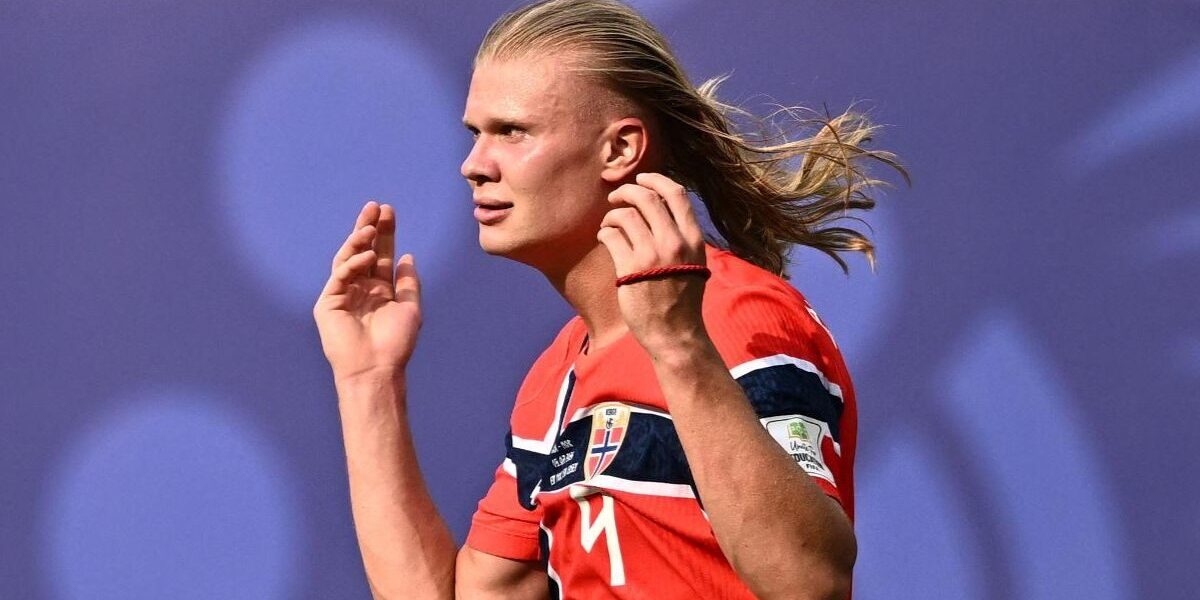
Erling Haaland is the highest-paid footballer in the Premier League, earning a reported £27.3 million a year ($36.5 million) at Manchester City, more than six million higher than the next name on the list. This summer he became the breakout viral star of the 2026 World Cup, spawning AI parody clips, waves of meme edits, and even a crypto token trading on his name. Haaland’s likeness was everywhere and one detail fans could not stop talking about was his hair… and what was holding it up. The intricately woven band holding his blonde man bun in place routinely survived over ninety minutes of sprinting, aerial duels, and the full-body violence of a Haaland celebration. And the brand name, printed on a tiny bead, was a word almost nobody outside of South Korea could pronounce.
On the pitch, Haaland’s tie was almost always red, the color of Norway’s flag and uniform. Fittingly, the deliberate coordination ran deeper than just one color. Haaland treats the accessory as part of his uniform, and when Norway wore their black change strip, he switched to a black band to match. The tie name is KKNEKKI, and it comes from kkeunaekki, a regional Korean dialect term meaning string or cord. The brand was founded in 1987 by Cho Hyun-tae, a businessman from Hamyang, a South Gyeongsang Province, who named the product after the way people back home said the word. The origin story seems almost fated: a frustrated former footballer wanted a hair tie that hurt less to put in and pull out. What he ended up making was less a hair accessory and more a small feat of textile engineering.
Each band is woven from more than sixty fine polyester threads wrapped around a flexi ble core, then capped with a bead. The weaving is done on vintage Korean knitting machines from the 1960s, this material was originally designed to produce heavy upholstery banding, which meant it had to survive decades of being sat on. Repurposed for hair, the technique yields a tie that grips without slipping, holds its stretch under real abuse, and slides free without snagging or leaving a crease. This is a very Korean kind of achievement, an ordinary/everyday object made ridiculously, almost obsessively well, and then quietly exported until it turns up on the head of the most feared striker on the planet.
In 2015, Cho signed a European licensing deal with Bon Dep, a family-run Norwegian accessories company, and moved manufacturing to an industrial complex in Chuncheon, South Korea. Bon Dep bought the brand outright in 2024 and now owns the design and the trademark, giving KKNEKKI a Scandinavian flair and a palette of more than seven hundred colors. The core of it, though, stayed in Chuncheon. Cho’s factory kept the exclusive manufacturing rights and the proprietary methods, which means that what keeps Haaland’s hair up is Norwegian on the label and Korean in the weave.
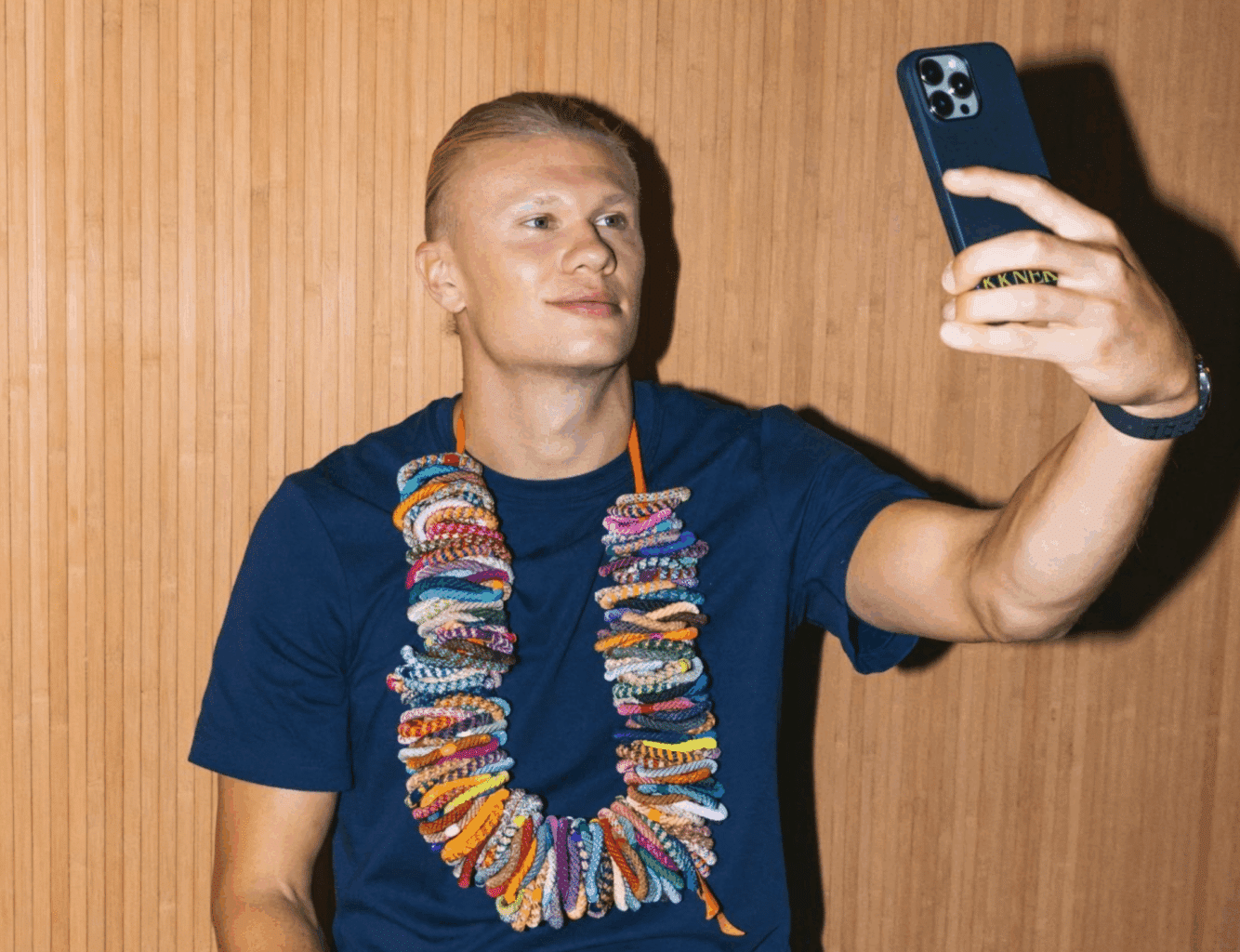
Haaland found it the way the best endorsements begin, by accident. He started wearing the bands in training and daily life because they worked better than anything else, and kept wearing them once the cameras were rolling. When Cho spotted the striker in them during Manchester City matches, he made custom bands in City’s sky blue and sent them over. The affection ran deep enough that in 2024 Haaland bought a minority stake in Bon Dep, going from customer to part-owner. “I wear KKNEKKI and have invested in the company because I believe in the product,” he has said.
The company’s revenue now runs in the neighborhood of seven million pounds. It’s easy to love everything about the KKNEKKI phenominon. One of the world’s most famous footballers is spotted being singularly loyal to a woven band created by a Korean former player, who sells the business to a Norweigen company. Then, the man (and Norweigen) most responsible for its explosive popularity ends up profitting off its success as both an ambassador and part owner.
Haaland’s World Cup star turn was tracked almost minute for minute both on and off the pitch. On July 5, in East Rutherford, New Jersey, he scored twice in the final eleven minutes to beat Brazil 2-1 and send Norway to their first World Cup quarterfinal in twenty-eight years. The run ended on July 11 in Miami, where England edged them 2-1 after extra time and Haaland, subbed off late, finished the tournament with seven goals.
In Korea, Haaland’s love for his Korean hair ties landed as equal parts trivia and pride. Searches for kkeunaekki spiked on Naver and Google, with older KKNEKKI fans recollecting buying “the best hair elastics” at Seoul’s Bangsan Market twenty years ago. And commenters from the ties’ hometown cheered the obvious: of course it came from Hamyang.
A limited “Haaland Edition” box, eight colors he picked himself featuring beads engraved with his name, sold out almost instantly. Bon Dep reported tens of thousands of new followers, with overall website traffic shooting up by seventy percent; and Norwegian traffic booming a startling 319 percent from its pre-World Cup numbers. The Chuncheon factory recently posted the best short-term sales in its history.
Getting one now takes a little patience. The official shop at kknekki.com carries the full rainbow, and a store locator points to roughly six thousand stockists, most of them in Europe, plus boutiques and Amazon listings elsewhere. Expect around sixteen dollars for a set of four. Two different kinds of colors are selling out at the same time. The everyday bestsellers are as you would guess: black and the neutrals, the shades people reach for every morning; black has its own deep catalog on the site, and several black styles now read “available soon,” quietly going out of stock after the World Cup rush. But booming alongside the expected popular colors are the hype colors, the ones Haaland wears, Norway red and Manchester City sky blue, with spikes whenever he plays. The signature Haaland box is gone for good, marked sold out with a note that it will not be restocked. For a hair tie that costs a few euros and started life as a dialect word, that is not a bad afterlife.