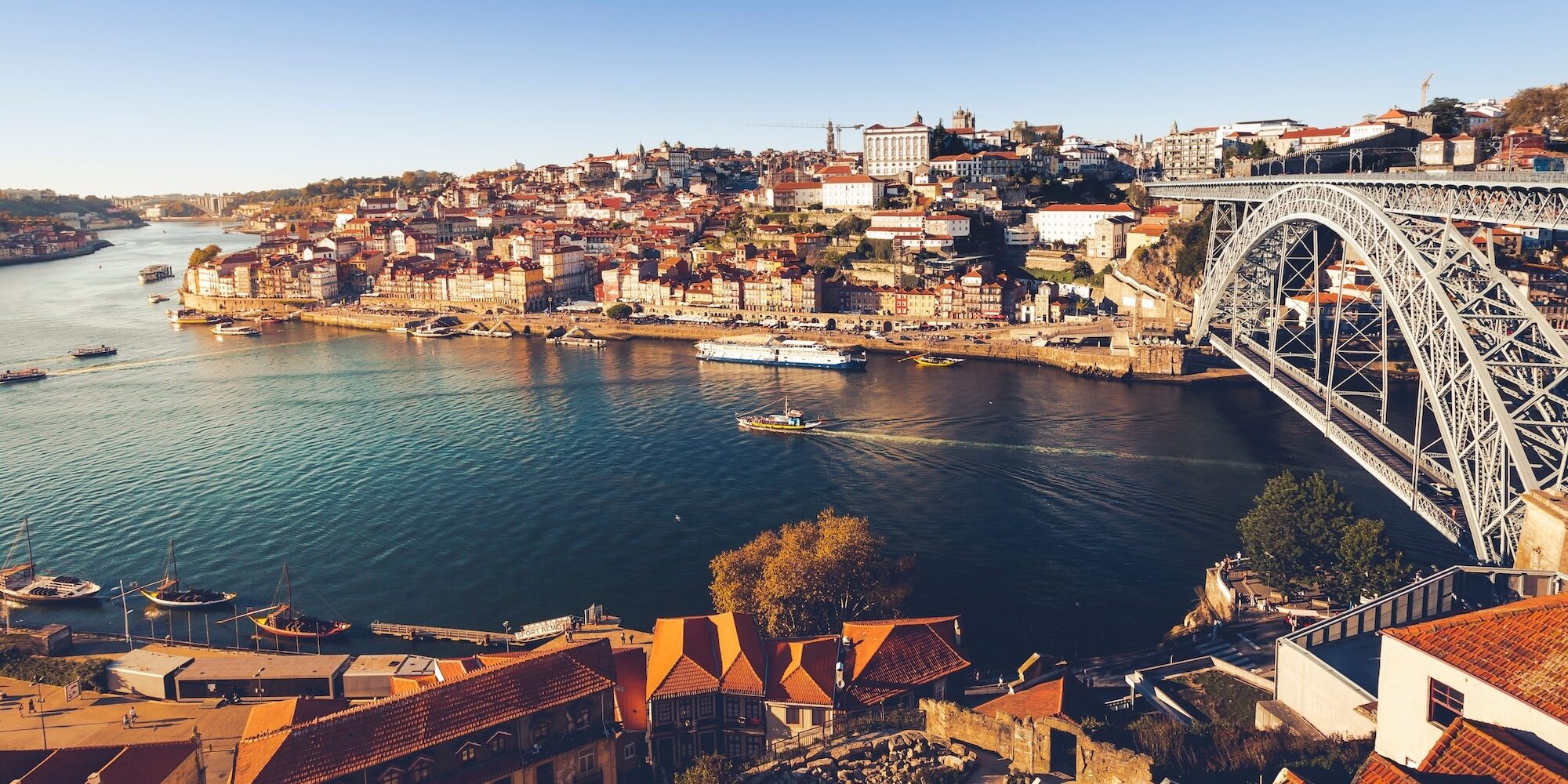
While my husband and I were eating a delicious bowl of naengmyun in Porto, Portugal yesterday, the Korean soccer player Hwang In-beom was finishing his meal at the table next to us at a lovely little restaurant called Wooa. He had just arrived in the city after signing a three-year contract with FC Porto, and amidst the excitement in the restaurant, it struck me that it was not my imagination. Everywhere I went in the historic city, I saw Koreans. Again and again I heard my native language in the air way more than I heard Chinese or other Asian languages.
Porto, most famous for its prized port wine, is a beautiful but modest city, some 230,000 people stacked into a set of granite hills above a river. What a lovely surprise to find that Koreans had already discovered this lovely destination and that in the last few years, Portugal has become a fixture on the Korean travel circuit.
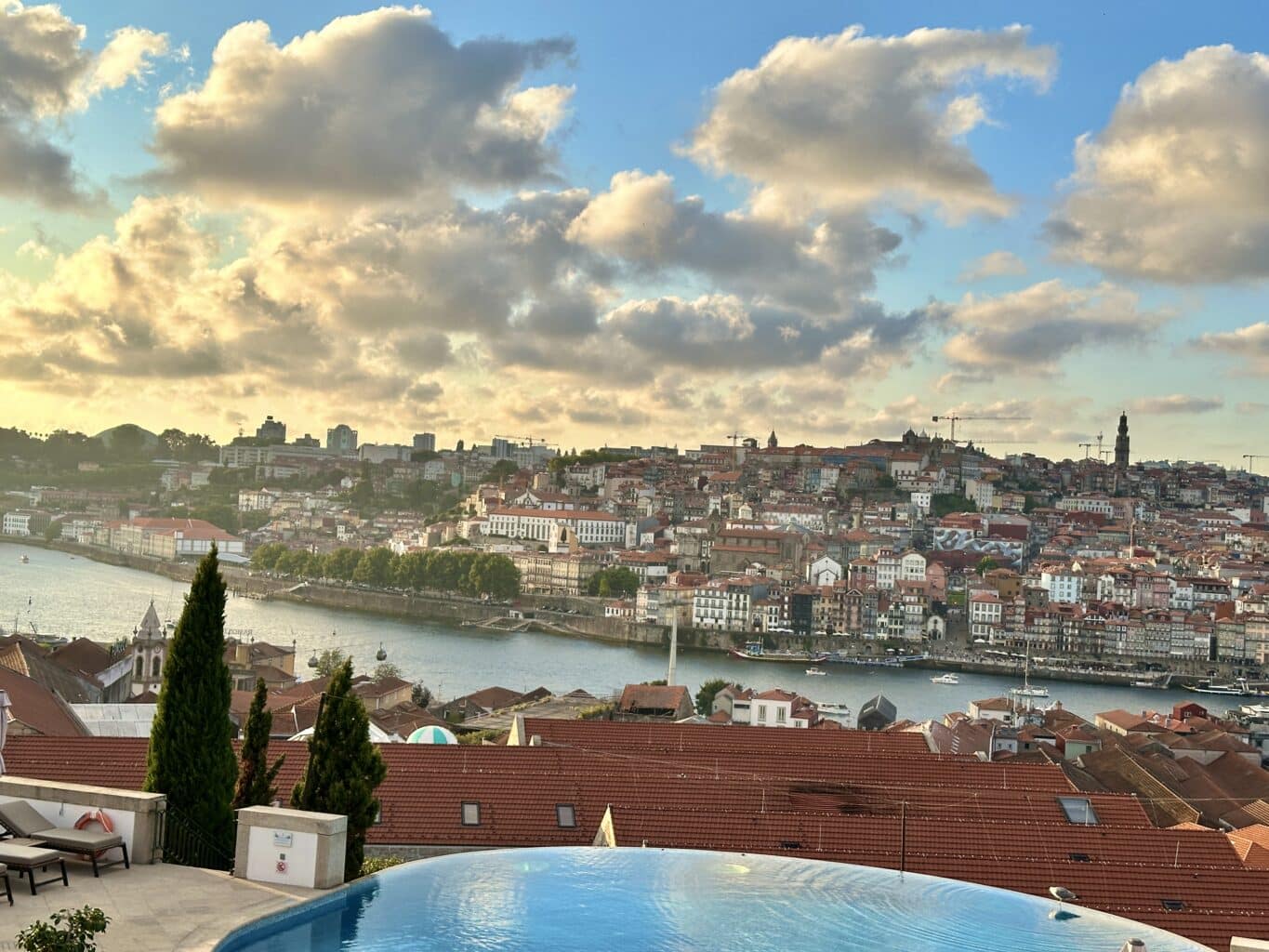
A view of Porto from the Yeatman Hotel, July 2026
Korean Air opened a direct route between Seoul and Lisbon in September 2024, three flights a week, and Portugal’s tourism board projected passenger bookings from South Korea to rise more than 44% from 2025 through 2026. With this convenient route now open, one of the top reasons Portugal has become so popular with Koreans has to do with money. Korean travel bloggers who cover Portugal tend to open with the math before they get to the wine: price surveys found Portugal running 20-60% cheaper than other major European destinations for lodging and restaurants. The cost factor is real but there’s also a vibe factor: several of Portugal’s pricier neighbors like Italy, France, and Spain have developed reputations for visitor fatigue, cities weary of the crowds that keep them running, and Portugal is truly a place where a tourist is still a welcome guest.
Beyond the cost and ease factors, there is an older and less transactional reason Porto is so popular for Koreans. The Sé do Porto (Cathedral of Porto) is a major departure point for the Camino de Santiago, and South Koreans have quietly ranked among the most consistent nationalities walking that pilgrimage for well over a decade. The credit usually traces to a 2014 reality show in which four elderly Korean actors walked the Camino. The unlikely image of four grandfathers walking for weeks in Europe with hiking poles launched a small publishing genre of memoirs and blog confessions and turned the Camino into something like a rite of passage for burned-out office workers and freshly retired parents. Many of those pilgrims lace up their boots in Porto and collect their Pilgrim’s Passport at the cathedral before heading north. Over the course of walking at least 12 days, travelers visit many charming towns and villages from the coast to the mountains before reaching their destination.
And then there’s the food. The cuisine simply agrees with a Korean palate in a way most of Western Europe doesn’t. Portugal eats more rice per capita than any other country in Europe, and some regions favor a short-grain japonica variety close to what Koreans eat at home. A seafood rice dish (arroz de marisco), spiked with extra spice on request, tastes like a genuine cousin of a Korean jjigae. The simply grilled fresh fish is a wonderful and inexpensive delight. Order the locally caught sea bass or bream and skip the salmon, which was probably flown in from Norway. One well-traveled blogger put it about as plainly as the sentiment can be put: Portugal was the only country on a long European itinerary that never once made her crave Korean food from home.
The Tourists Who Aren’t There
Spend a day in Porto and you’ll notice the usual crowds of visitors along Ribeira. What’s surprising is how few Chinese tourists are in the mix, a striking gap given how thoroughly China has come to dominate outbound travel almost everywhere else in Europe. There are 28 direct weekly flights from Italy to China, France 70, Germany 87, while Portugal has spent most of the past several years with no direct Beijing route at all. No direct flight tends to mean no easy package tour, but it’s a gap that is soon likely to close given the many charms of Portugal.
Reprieve From the Heat Dome
The last couple summers have been brutal for Western Europe. A heat dome settled over the continent in late June and reloaded again in July, setting an all-time national record in Germany and pushing readings past forty-five degrees Celsius in parts of Spain and southern France. Inland Portugal did not escape this, but Porto sits on the Atlantic, and that geography has bought the city a reprieve from the same weather system scorching the continent’s interior. Summer in Porto has been breezy, clear, and warm without the punishing edge gripping everywhere east of the coast, while staying warm enough for swimming. Porto has real beaches a short ride from the center, and Matosinhos, just up the coast by metro, runs consistent, beginner-friendly waves that have kept surf schools in business for decades. A lesson or two slots easily into a city trip.
If You Go
ATMs. Don’t do what I did by using the wrong ATM machines, which charged me over 20% in fees. Porto’s streets are dense with Euronet machines, easy to spot by their blue and yellow branding, and they carry punishing fees on top of a genuinely bad built-in exchange rate. Look instead for the Multibanco network, marked by a small square “MB” logo, the system Portugal’s own banks actually operate. When a Multibanco machine asks, twice, whether you’d like the withdrawal converted to your home currency, decline both times, and you’ll get the standard rate rather than a padded one. Search Google Maps for “Multibanco” specifically rather than “ATM,” which tends to surface Euronet first.
Getting around. Porto’s hills are not a figure of speech. Both sides of the Douro River, Porto and Gaia, are built on hillsides, which can be very steep cobblestones stacked on inclines, which Google Maps will not warn you about. Bring sneakers and expect to feel it in your calves by day two. A tuk-tuk tour handles this cleanly, and it’s a genuine pleasure in its own right, not just a workaround: small electric vehicles wind through Ribeira, past the cathedral, down Aliados Avenue, and up to viewpoints most walking tours skip because the climb asks too much of a group. And when the hills finally win, which they will, there’s no shame in surrendering to a ride. Uber runs reliably across the city, and it is remarkably cheap by the standards of most European capitals, a 20-minute ride across town often costs less than a coffee back home. Bolt, the European ride-hailing service, tends to be cheaper still for the same route.
Language. English fluency runs high in Porto’s tourist-facing businesses, restaurants, hotels, and shops, high enough that getting by without a word of Portuguese is entirely realistic. For Korean-speaking travelers, there are plenty of Korean-guided tours available. Check Korean travel sites to sign up for the tours.
Eating Korean Food. Go to WOOA Korean Grill & Dining, a cozy new restaurant in a historic alleyway near the river. It’s run by a pair of sisters-in-law whose warmth toward guests is like having some local friends in Portugal. Ask for one of the tables by the open window and enjoy the lovely Porto breeze. Whatever you decide to order, get a bowl of delicious naengmyun to finish your meal.
Coffee. It’s genuinely, distractingly good, and worth understanding why before the trip is over. Portuguese roasters typically blend Arabica with Robusta rather than working with pure Arabica, and they roast slower and at a lower temperature than the classic Italian style, which softens the bitterness without flattening the flavor, while the Robusta lends real body and a thick crema. In Porto specifically, order an espresso, and you’ll hear it called a cimbalino, a local name inherited from the Cimbali machines that first served it. And Portuguese cafés don’t observe the Italian rule that a cappuccino past eleven in the morning marks you as a tourist, so feel free to order one at four in the afternoon if that’s what sounds good.
Livraria Lello. Buy the tickets in advance and don’t be discouraged by the hype. Yes, the line outside can be long, and yes, half the people filing through are there because of social media. But none of that changes the fact that the staircase and the stained-glass ceiling are genuinely, almost absurdly beautiful in person. The ticket price gets credited toward book purchases inside, and the shop carries a nice selection of English-language books, so the money isn’t lost. Everyone could use a bit more reading and a bit less scrolling anyway. The Majestic Café is a very pretty cafe where J.K. Rowling wrote some chapters for Harry Potter while she was living in Porto. If you don’t want to wait in line, just take a peek inside.
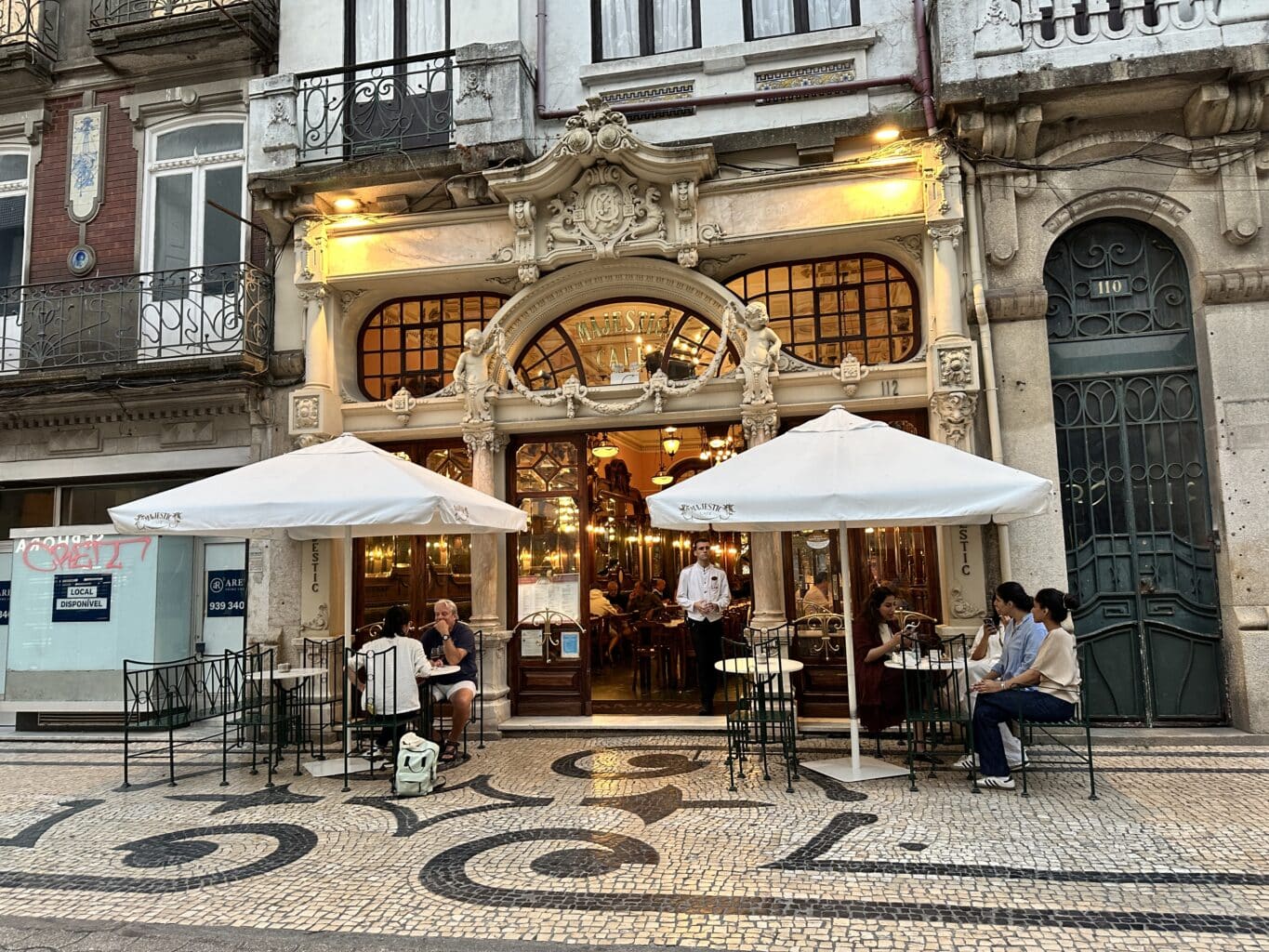
The Majestic Cafe, Porto, where JK Rowling wrote some chapters of “Harry Potter” | July 2026
Port Wine and the Douro Valley. Wine alone is reason enough to visit Porto, but the terraced vineyards of the Douro Valley are worth a trip. Close enough for a day trip, roughly ninety minutes by car or train to Pinhão, and plenty of people do exactly that: a morning drive, a couple of wine-cellar tastings, a lazy lunch on a quinta terrace, back in Porto by dinner.