“Life is weather. Sometimes you’re in it, and there’s nothing to be done. Tragedy is when you can’t endure it anymore.” -CRL
From the very first page, A Tender Age strikes straight at the heart. In a world that seems to move forward with accelerating speed, Chang-rae Lee gently reminds us to not misplace our precious everyday fortunes, which are many, if we only take the time to look.
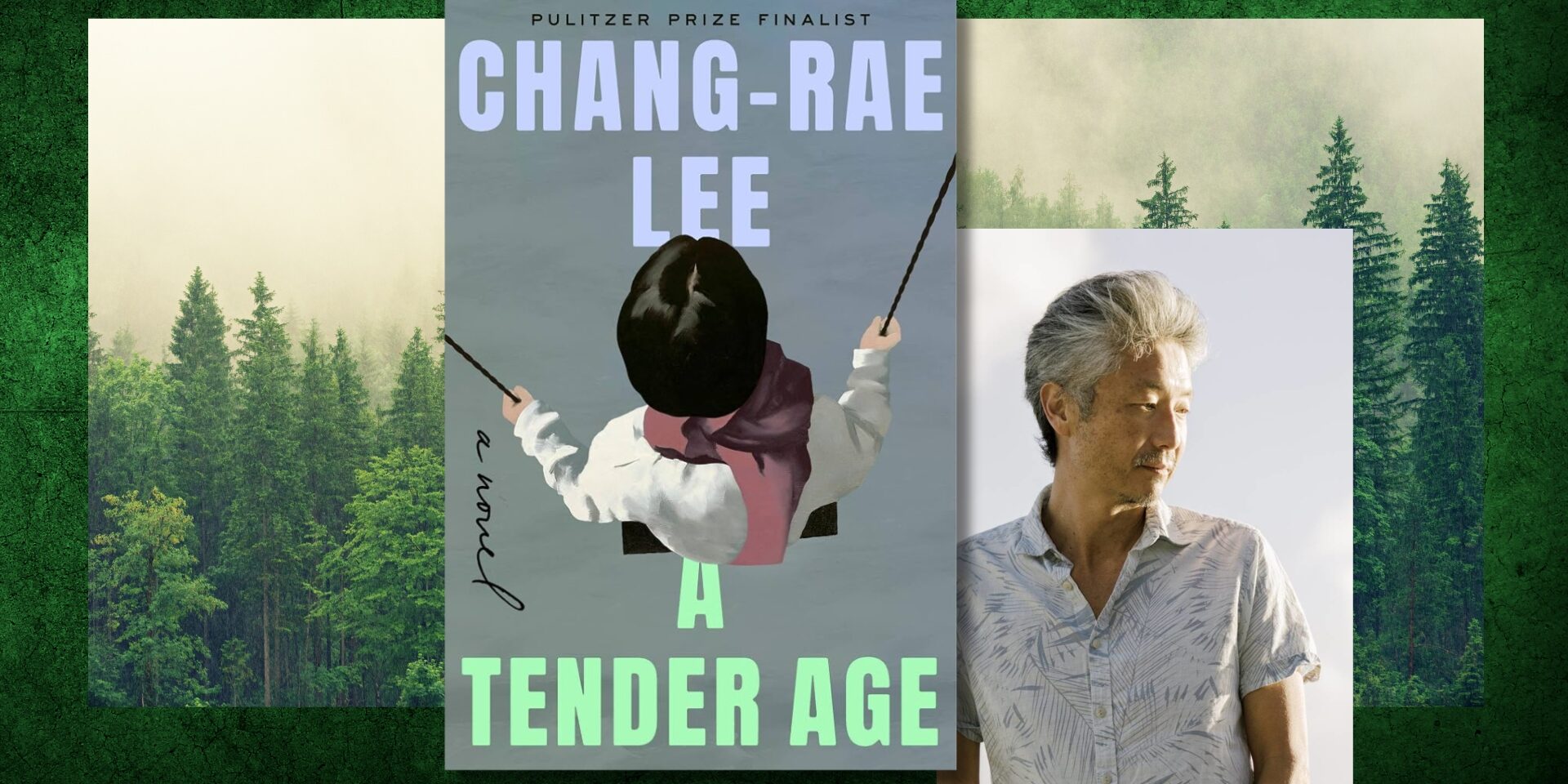
This is Lee’s seventh novel, and his most personal. Three decades into a celebrated career, he has turned back to the childhood he remembers. Set in 1970s New Rochelle, the novel follows Jeon-Gi, the son of Korean immigrants, who is caught between his parents’ fierce love and the world beyond the walls of home. It is a book about a love that, however deep, cannot shelter a child from the storms of life.
Jeon-Gi’s childhood closely follows Lee’s own: a tenement apartment building, summer camp, a rough playground, the double life of an immigrant kid. Lee’s lyrical prose lands deep as he recalls a vibrant world before technology stole our attention and seatbelts kept us safe.
Lee is one of the most acclaimed novelists of our time. His debut, Native Speaker, won the PEN/Hemingway Award, and The Surrendered was a finalist for the Pulitzer Prize. He has also been a finalist for the National Book Critics Circle Award and has won the Dayton Literary Peace Prize and the John Dos Passos Prize for Literature. Apart from writing novels, Lee is a professor of English at Stanford University.
This deeply affecting novel will often make you pause both to catch your breath from some terrifying moments and to marvel at Lee’s gorgeously rich prose. While in New York on his book tour, Lee sat down with us to talk about his new novel, the family at its center, and the strange, sometimes haunting ways the past lives on inside us.
PL: It has been five years since our last interview. You had just published My Year Abroad and were spending a lovely pandemic summer in Italy. What has changed most in your life since then?
CRL: Age. Which comes with a lot of things that are both wonderful and alarming. Our daughters are older now. They’re young women, and one is engaged. You can begin to see the shape of the next generation, and maybe even a third generation, and you start to think about the span of everything. My parents are gone. My mother died many years ago, and it’s been almost ten years since my father passed away. So there’s a little more retrospection. Life catches up with you, one hopes in a good way. I don’t know anyone alive who’s had a completely smooth ride.
I’ve been in New York for my new book, and I got together with some of my old Korean friends, including people I know from summer camp. Our kids are all around the same age now, in their mid- to late twenties. When the kids were younger, everyone was trying to optimize everything for them. But now that they’re older and more settled, we’re thinking, well, this is who they are, and wondering whether all the things we did really mattered. In the end, they each have their own momentum, their own vectors. Some are doing what they want to do, and some are still searching.
What I noticed among my friends was a genuine circumspection. At this point in our lives, we’re all aware of the troubles, the difficulties, the uncertainties.
You have published a novel roughly every five years for the past three decades. What does the discipline of writing mean to you?
Normally, I work in the mornings. I put away the phone. It’s pretty simple. My wife will tell you that I go away and get obsessed with the things I really care about. It’s not a mystery. My butt is in the chair.
You have been teaching for many years. How have your students changed, particularly over the past few years?
They all seem to be doing AI! I guess students gravitate toward where the jobs are. They aren’t all students who want to be writers, just really smart kids who have written all their lives. At the start of class, I always ask what they’re studying, and last year two-thirds of them said AI. Whatever else they’re studying, I guess they have to be literate in it.
As always, the students are motivated and smart, and they come from many different backgrounds. Stanford is fortunate to bring in a lot of first-generation students. But students are a little more anxious than they were when I started teaching twenty-five years ago. I think because of technology and their phones, they know too much.
I have heard you say that it is very difficult to help a good writer become a great one. How much of writing a novel is skill, and how much is magic?
It’s not magic. I think it takes a certain kind of disposition, because writing novels is so hard. I think it’s one of the hardest things to do, because you’re the sole creator of everything.
In the last few years I’ve been doing some film and television work. You write a script, and even if it’s a good script, it’s just the beginning of the process. There are so many other people involved. I recently wrote the screenplay for Ang Lee’s upcoming film Gold Mountain. We were out on location looking at possible sets, and one of the set designers asked me about a wheelwright’s shop I had described in the screenplay. It turned out they had gone to their workshop and started making models of the things I wrote about. I had written a sentence and a half about a wheelwright, and it launched a thousand ships!
So in film, you depend on a lot of other people to create the world. In a novel, you have to do all of those jobs yourself. It takes someone who can handle all those moving parts, push them along, and make the whole thing hold together. It’s often too much to think about, and writers fall off at any given point. It can be too much to handle, especially if they’re perfectionists. It’s also so easy to get stuck. There are a million ways to fail at writing a novel.
A lot of us who do this work just push on. Maybe that’s the magic. You ignore all the warning signs and keep moving forward.
Your new novel, A Tender Age, affected me deeply in many ways: as an immigrant, as a mother of boys, and as a child of the 70s. While you were writing it, did you sense how powerfully it might affect readers?
I really don’t think about the reader that much. Everyone is so different. Something that hits one person really hard can leave someone else cold. That’s humanity.
Sometimes after writing certain scenes, I’ll feel it. That’s a good test for me. Even though I’ve been thinking about a scene and picking it apart in a cold-blooded, clinical way, if I still feel something after reading it for the fourteenth time, I think, well, maybe it’s working.
This is a book with a lot of events and situations. It’s about childhood, which is a time when everything feels like it’s happening to you all at once. And you remember things so clearly, what your mother made you for lunch, how you argued with your sister. It’s a dense time and a colorful time, and I wanted to place the reader back in that mode.
A Tender Age is set within a Korean immigrant family in the 1970s. How much of Jeon-Gi’s world came from memory?
The structure of Jeon-Gi’s life is fused with my own: growing up in a tenement building in New Rochelle, going to summer camp, the way we played on the playground. The basic structure is very close to my life at ten. Nothing is exact, and it is certainly fictionalized, partly or wholly, and enhanced.
In some ways, many first-time authors write a book that is their life but not really their life, one that contains the truth of that life rather than the literal events of it. Somehow, I hadn’t written that book until now.
Several deeply disturbing events occur as Jeon-Gi approaches his eleventh birthday. Did any of them draw directly from your own childhood?
A lot of what happens in the book didn’t happen to me exactly, but it definitely could have. I was very afraid of the things that could happen to me. Thank God those things didn’t happen to me exactly! I’m not sure those events could so easily happen now, since kids are so monitored and supervised. In that sense I suppose this is a kind of historical novel, set in a very specific period before what we now accept as normal parental oversight, when many bad things could and did happen. We didn’t wear seat belts! Metaphorically, that’s how it felt. You could come very close to something terrible occurring.
I remember an incident at camp when I accidentally hit my male counselor in the groin and really hurt him. It shook me because I loved him and looked up to him. I was six, and it was my first year at camp. I really depended on him, so I remember being very frightened. I had an emotional reaction as intense as if I had done something to my father or mother. I suppose that’s the kind of feeling I carried into the scenes I ended up writing.
Jeon-Gi has a very special relationship with his mother. How does it compare to your own relationship with your mother?
In Jeon-Gi’s relationship with his mother, I tried to capture a really deep and unbreakable love. But sometimes even that deep a love and bond doesn’t matter.
Inside our own life, our own apartment, we had one life and one way of communicating. In the public world outside, everything was very different, and we played different roles. Immigrant kids understand that extra layer. I wanted to protect my mother by not telling her about certain things, even when I desperately wanted to tell her because I needed her help and protection. It’s partly cultural, because we’re immigrants, and partly because you’re just a kid.
There were things I felt she would never understand, so why even bother? I didn’t want to give her one more thing to worry about. She worried about us so much, even though we were okay.
His mother’s love and attention give Jeon-Gi tremendous strength, but they also help breed a certain brutality in him. When did you first recognize brutality in yourself?
I think all kids recognize it at some point. We’re taught not to be that way, but certain feelings and impulses well up, certain moments when you’re not quite in control. We want to be benign, but little malignancies crop up.
In the novel, Jeon-Gi starts lying to his good friends. It’s not a big thing, but these tiny transgressions are part of his growing up. He’s trying things out, going beyond a certain limit. The problem with Jeon-Gi is that he keeps pushing. He gets pushed, and then he keeps pushing until he goes too far. Maybe he’s wondering what’s on the other side of the limit: cruelty, selfishness, social greed.
Writers often depict spoiled children as insufferable brats. A Tender Age instead explores the burdens and guilt of a child who may be loved too much. Do you think Korean families are especially prone to spoiling their children?
Yes! Especially the number one son. That comes with a lot of other things, including expectations. Jeon-Gi knows he’s spoiled, and he takes advantage of it. It makes him proud but also petulant because he feels as though he’s at the helm of the boat they’re all on. He’s their hope, and that’s a lot of pressure. It’s a heavy burden.
Maybe that’s the other face of unconditional love: the accumulation of pressure, weight, and expectation. Maybe the outlet for that is doing something antisocial and transgressive, testing what lies on the other side of being the golden child.
I think this upbringing also brought out my creativity. There was always something in me that urged me to try difficult or frightening things. I certainly didn’t feel as though I could do anything, and I’m not a daredevil. But intellectually and psychically, I was restless. I was bored with the normal. I know my mother didn’t teach me that, because she just wanted me to be normal.
From very early on, I was always a little restless. Also, if you try something and it turns out okay, you have a little less fear the next time. I’ve learned to overcome my fears. I still have them, but I feel that if I’m interested in doing something, I should do it. I don’t mean physical risks so much as intellectual ones.
Jeon-Gi has a very different but equally special relationship with his father. How would you describe it?
There’s a power in Jeon-Gi’s father in simply being steady, in telling you that it’s going to be okay. My own father was always like that. He could get angry about minor things, but when something got really bad, he became very calm. I learned a lot from him that way.
He was a wonderful, gentle guy, not like the stereotypical Korean father. He wasn’t imperious, and he deferred to my mother a lot. After my mother died, it was difficult, but he eventually remarried and had a good life.
I always felt that he fully supported me. I really appreciated that, though I wasn’t as grateful as I should have been. I went to boarding school, so I left home fairly early. It was a great thing for me, but it would have been wonderful as well to spend more time with him.
Jeon-Gi’s self-proclaimed laziness and lack of resolve and talent made me laugh out loud. Are you personally familiar with any of those traits?
Yes! My mother would always say, “You’re so lazy.” I’m lazy about the things you’re supposed to do. Sometimes I don’t make my bed. But I tend to get obsessed with the things I really want to do. I’m selectively hardworking. You can’t do it all!
I never felt that I was especially talented. You have interests, and if you keep working at them, you end up getting pretty good at some of them. Maybe you won’t be the best, but you’ll become decent. Take golf. I have an interest in golf, because it’s such a complex game. I work a bit at it, and I’m decent. But in the end I must not really care that much because I probably should work at it more, but I don’t. I guess I enjoy the camaraderie more than playing well, which is just fine with me.
The passage about peeling open a “baton” of Ritz Crackers was such a sweet bit of nostalgia. Surely Korean immigrant families were the only ones who regarded that snack with such high esteem?
Do you remember the color and feel of that wax paper wrapper? The baton is a totem of our childhood, yes? I don’t think other people would feel quite the same way. Our parents valued it in a certain way, and in turn, so did we.
One of my favorite characters is Sir Marbles, a hardened criminal who appears only briefly but leaves a lasting impression. What inspired him?
When I was growing up, New Rochelle was very diverse. There were people from everywhere. There were some pretty rough characters, like the character Cleon’s older brothers, who drank beer and smoked pot on the playground. They talked about people like Sir Marbles, young adults who got caught up in trouble.
So Sir Marbles isn’t a “criminal.” He’s a kid acting out against the brutality inflicted on his mother. That was something I heard about back then, kids whose siblings were in jail or juvenile hall for petty stuff or by being involved in some unfortunate circumstance. That was shocking to me.
For Jeon-Gi, he knows circumstance pushed Sir Marbles into committing a serious crime, but I think he also is beginning to understand that maybe not everyone would do what Sir Marbles did. Not everyone can be pushed into such brutality. There’s something in Sir Marbles, and maybe something in Jeon-Gi, too, that is resident, part of his character.
The torrential rainstorm at camp reminded me of a similar experience my son had at sleepaway camp. He still shudders when he remembers the misery. Is pain something parents should try to prevent when possible?
It’s not possible to prevent it. If you shut children away in a box, you create a different kind of pain, the pain of being overprotected. Of course, you can buckle them in. You do everything you can to keep them physically safe.
My parents were always telling me to be safe. I do the same for my adult daughters. But horrible things can happen. Accidents, bad timing, bad luck, like my mother’s cancer. No one wants to be negligent, we try the best we can, but beyond that, what can we do?
Life is weather. Sometimes you’re in it, and there’s nothing to be done. It’s simply a force. You can’t prepare for everything. You just have to deal with it, endure it, until it blows over. Tragedy is when you can’t endure it anymore.
I found great solace in the flashback structure, because I knew that Jeon-Gi had at least survived the perils of his childhood. How much of the life he builds was shaped by what he endured as a kid?
A lot of it. Adult Jeon-Gi is ‘fine’ in most respects, but of course a key part of him isn’t ‘fine.’ I think he’s someone who figured out that he has to keep going. He keeps moving forward. His sister, Ella, is special and talented. He’s not that, but he’s persistent. It isn’t about what he has or doesn’t have. He hasn’t given up. No matter where you are, you just keep going.
What are you thinking about for your next novel?
My wife and I first got to know each other on a road trip from New York to Oregon. I’m thinking about that trip, and how it might be the spine for a novel. The book will play out differently of course, but I like the narrative possibilities of that journey, a youthful romance that goes back and forth in time. ◆
A Tender Age by Chang-rae Lee, Available now on Amazon.