“If adults are afraid of children, the world is doomed.”
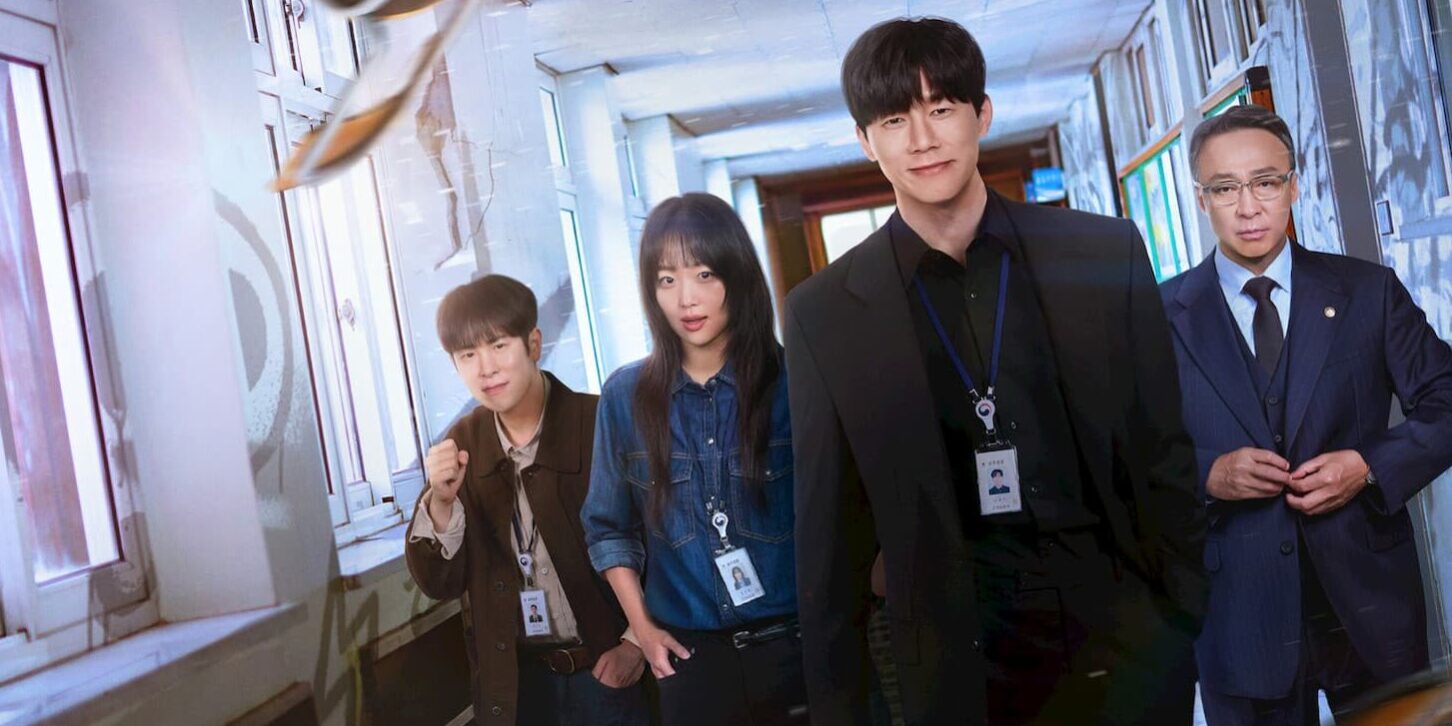
The line belongs to Na Hwa-jin, a former special-forces captain turned education inspector played by Kim Mu-yeol in Netflix’s Teach You a Lesson. By the second episode, it has become a mantra that echoes throughout the series. Korea’s real-life education system in recent years has been taken hostage by its own well-meaning laws, and an audience hungry for justice has shown up for some fantasy revenge.
A wave of vigilante dramas like Vincenzo, Weak Hero, and The Glory has swept Korean television in recent years, and Teach You a Lesson found a huge audience eager for more. Where earlier Korean revenge dramas focused on individuals settling personal scores, Teach You a Lesson hands that fight to an institution. Since its June 5 premiere, it has drawn more than 46 million views, the fifth most-watched Korean series in Netflix’s history, behind only the three seasons of Squid Game and All of Us Are Dead. It held No. 1 on Netflix’s global non-English chart for four straight weeks.
The series follows the Educational Rights Protection Bureau (ERPB), a fictional government department founded after a teacher is killed by a student. With extraordinary legal authority to disregard all school rules and laws, including the ban on corporal punishment against minors, the newly formed ERPB is on a mission to protect victims of Korea’s problematic education system with methods that are intentionally provocative and controversial.
The Bureau delivers a clear message: it’s the adults’ responsibility to step up. In order for the country to truly learn its lesson, small local efforts aren’t going to cut it. The government’s enduring, organized involvement is necessary.
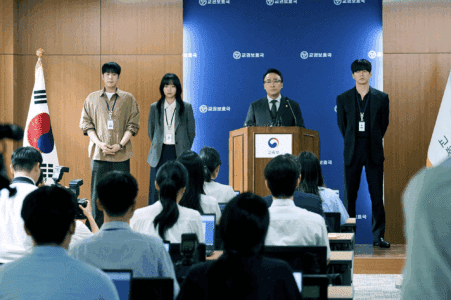
Lee Sung-min, Kim Mu-yeol, Pyo Ji-hoon, and Jin Ki-joo in Teach You a Lesson (2026)
A New Crisis in Korea’s Education System
While the pressure cooker environment of Korean schools has been a well-known problem for decades, a new crisis has emerged in recent years, one that makes the show resonate so deeply: Korea’s laws have swung so far toward minors’ rights that the classroom has come apart. Teachers, once among the country’s most respected professionals, now describe their jobs as a kind of hostage situation, at the mercy of disruptive students and, more often, the parents behind them.
That imbalance is the real subject of the show. Across ten episodes, the Bureau’s three investigators work case by case through the toughest school challenges, including cases of widespread drug use, social media abuse, predatory online gambling, and the notorious bullying by students and parents. The Bureau’s argument is not that students deserve less protection. It’s that too much protection, unmoored from accountability, has morphed into neglect, and that a classroom without adult authority is not freer but more dangerous.
“The Korean education system has failed its students. Our children no longer have respect for their teachers, and our teachers are now terrified of their students. And so, how can we expect any learning to take place when teachers have been stripped of their authority?” -TYAL (Teach You a Lesson)
Several episodes are based on real-life tragedies, including the suicide of a 23-year-old first-grade teacher and the Wi-Fi Shuttle bullying incident.
Korea’s educators resonate with the series’ all too accurate depictions of modern parents’ and students’ strong sense of entitlement. The Korean Federation of Teachers’ Associations shared in a statement: “The series lays bare the harsh realities of today’s classrooms, including the breakdown of classroom order, serious violations of teachers’ rights by some uncontrollable students, and the sense of despair felt by educators left powerless after being inundated with malicious complaints.” The KFTA recorded 438 cases involving violations of teachers’ rights in 2025 alone.

An exhausted school teacher and Kim Mu-yeol in Teach You a Lesson episode 3.
“The teaching of knowledge, skills, and the cultivation of character. That is what a true education is. Good universities and good jobs are important, but what is more essential is nurturing a person’s integrity and their moral compass as well.” -TYAL
South Korea’s hyper-competitive education system has normalized the high youth suicide rate (South Korea has the highest suicide rate among OECD countries). Chronic fatigue is reported in elementary students, with only 52% of elementary students getting sufficient sleep in 2023. Pre-med tracks can start as early as elementary school, and there is a deepening educational inequality with eight in ten students receiving supplemental private education, averaging 590,000 won (about $445) per month per student due to academic pressure and the crushing weight of performance-based identity.
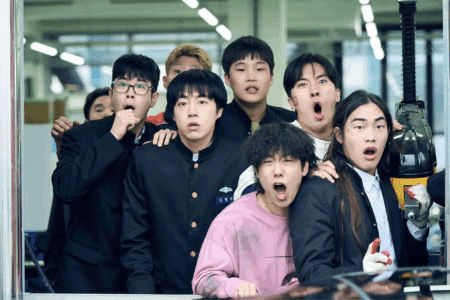
Students in Teach You a Lesson marvel at Kim Mu-yeol.
A Star Long in the Making
Kim Mu-yeol anchors the show. At forty-four, he arrives with two decades behind him: a musical-theater lead in his twenties and a slow climb through minor roles before his breakout role in Juvenile Justice in 2022. As Na, he seems born for the part, carrying out the Bureau’s philosophy in a calm, world-weary voice. His tough guy character can be brutal, but he cares deeply about his mission and about victims. Kim topped Korea’s individual cast buzz rankings the week the show debuted, and critics have credited him with masterfully juggling comedy and grief with impressive combat skills.
His co-stars shine as well. Lee Sung-min, as Education Minister Choi Gang-seok, the father who founded the Bureau after his own daughter’s murder, plays a man reluctantly authorizing violence as a last resort. Jin Ki-joo, as fellow inspector Im Han-rim, a former military officer with her own history of being bullied, is Na’s incredibly intense right-hand woman. Pyo Ji-hoon, the singer known as P.O., rounds out the team as its tech support officer, supplying a regular dose of comic relief.
Fighting Fire with Fire
“Violence is higher than ever, yet you expect teachers to fight back with nothing but chalk? The Bureau’s intention isn’t to fight the students. It’s to fight the monsters who threaten fellow students. And a monster can only be taken down by another monster.” -TYAL
While using corporal punishment as entertainment is uncomfortable for some viewers, many will find it incredibly satisfying to see the swift efficacy of a good old-fashioned smackdown. “It was about time to see a real adult in charge,” one viewer commented on the trailer.
“Although the series raises valid questions about how dire conditions have become in some schools, it also raises concerns that viewers could come away believing that violence against students is in some ways a necessary part of education,” said a middle school teacher in Seoul. In a statement, the Korean Federation of Teachers’ Associations additionally stressed that “what teachers need is not a fist, but legal protections.”
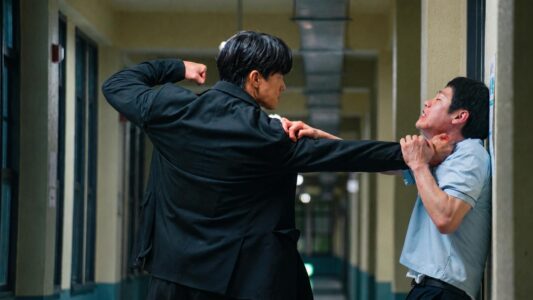
Lee Bong-joon and Kim Mu-yeol in Teach You a Lesson (2026)
Controversy over the Source Webtoon Material
The series is based on “Get Schooled,” a Korean webtoon that received backlash for racism, sexism, and glorifying excessive violence. In 2023, Naver Webtoon issued an official apology and removed “Get Schooled” from its North American platform, while placing the original Korean version on indefinite hiatus.
“Personally, I believe corporal punishment in any form is unacceptable and wrong. We tried to approach the story through a more refined lens and create something meaningful,” Director Hong Jong-chan shared at a press conference. “What drew me to the original was the idea of standing beside victims and offering them support. That was the core appeal that made me want to adapt it.”
Viewer Takeaway
Director Hong hopes the series will prompt audiences to reflect. “People will undoubtedly view this story from different perspectives, but I hope it encourages audiences to think about what each of us can do from our respective positions.”
The fantasy has migrated into real policy debate. Ahn Min-seok, the incoming superintendent of education for Gyeonggi Province, has proposed building a real, regional version of the Bureau, citing the drama by name. The Democratic Party’s policy think tank has floated a rival, non-violent version, an Education Activity Protection Bureau meant to centralize how the state handles complaints so individual teachers stop absorbing them alone. The Korean Federation of Teachers’ Associations has welcomed the attention while making its own position plain: what teachers need is not a fist, but legal protection built into the system.
Whether either proposal survives Korea’s National Assembly remains to be seen. Netflix has not confirmed a second season, though Hong has said he would send the Bureau wherever the perpetrators are. What’s already certain is that Teach You a Lesson took a country’s long-suppressed anxiety about its own classrooms and, for ten hours, indulged the fantasy of an adult willing to stand between a child and the damage he’s about to do, to himself or to someone else.