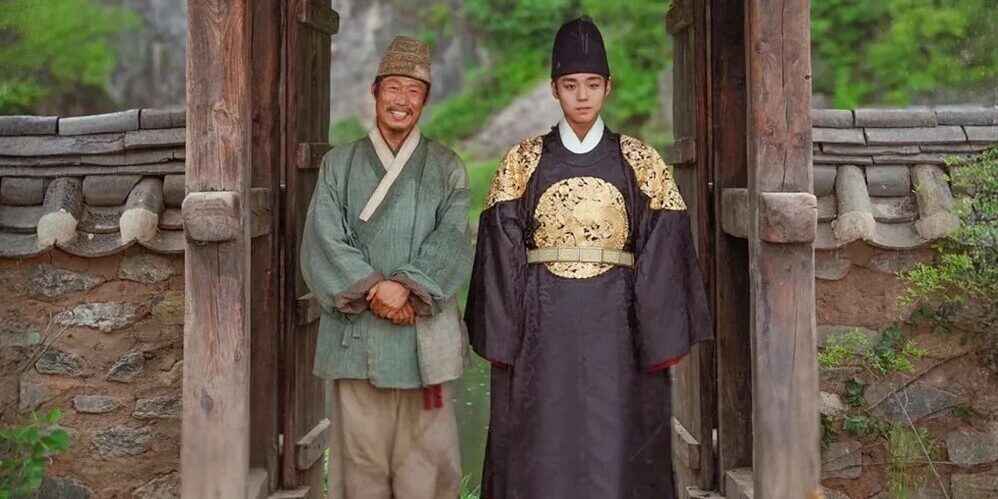
Five months after becoming a box office phenomenon in South Korea, The King’s Warden is finally available to stream in the United States on VIKI, and it is well worth the wait.
Credited with bringing audiences back to movie theaters in record numbers, the film became Korea’s highest-grossing film of all time. It also won four major awards at the 62nd Baeksang Arts Awards in 2026, including the Grand Prize for lead actor Yoo Hae-jin.
The tragic story of the young King Danjong is one every Korean grows up hearing. It is a historical wound our culture has frequently revisited for generations through novels, television dramas, and films. When I first learned that The King’s Warden would have a limited release in American theaters back in February, I was excited to see it but wondered whether another retelling of this familiar story could really offer anything new. Sitting in an AMC theater in the heart of Times Square, surrounded by a diverse New York audience that laughed out loud and visibly shed tears, I realized I was watching something very different.
A Different Kind of Historical Film
Rather than centering the film on the political intrigue that culminated in Danjong’s overthrow, director Jang Hang-jun instead focuses on the story’s emotional consequences. The title itself reveals the film’s unlikely lead character. Instead of following kings and generals, The King’s Warden tells the story through the eyes of Um Heung-do (Yoo Hae-jin), a village official who, according to history, risked his own life and the lives of his family to protect the exiled boy king.
In The King’s Warden, Yoo gives one of the finest performances of his career. He conveys han and jeong with an economy of expression that reminded me of Anthony Quinn in La Strada. Little is known about the historical Um Heung-do, yet the screenplay, the direction, and Yoo’s performance create a character who anchors the film with quiet humanity.
The screenplay also offers a refreshing interpretation of Danjong himself. Rather than portraying him as the helpless victim (like many earlier retellings), it presents him as an intelligent, spirited teenager whose courage survives even after he loses his throne. Together with Prince Geumseong, the three characters humanize the story’s political tragedy with moments of warmth and humor.
As memorable as these performances are, the character who most stayed with me long after the credits rolled was Han Myeong-hoe, played with chilling restraint by Yoo Ji-tae (Old Boy.) The performance is especially compelling because the historical Han was, arguably, even more remarkable than his cinematic counterpart.
Han Myeong-hoe was one of the most consequential political figures of fifteenth-century Korea. He appears in the Annals of the Joseon Dynasty roughly 2,300 times, a feat seldom met by anyone who was not a king. He engineered a coup, defeated a countercoup, married two daughters into the royal family, served three times as Chief State Councillor, installed three kings, and lived to the remarkable age of seventy-three.
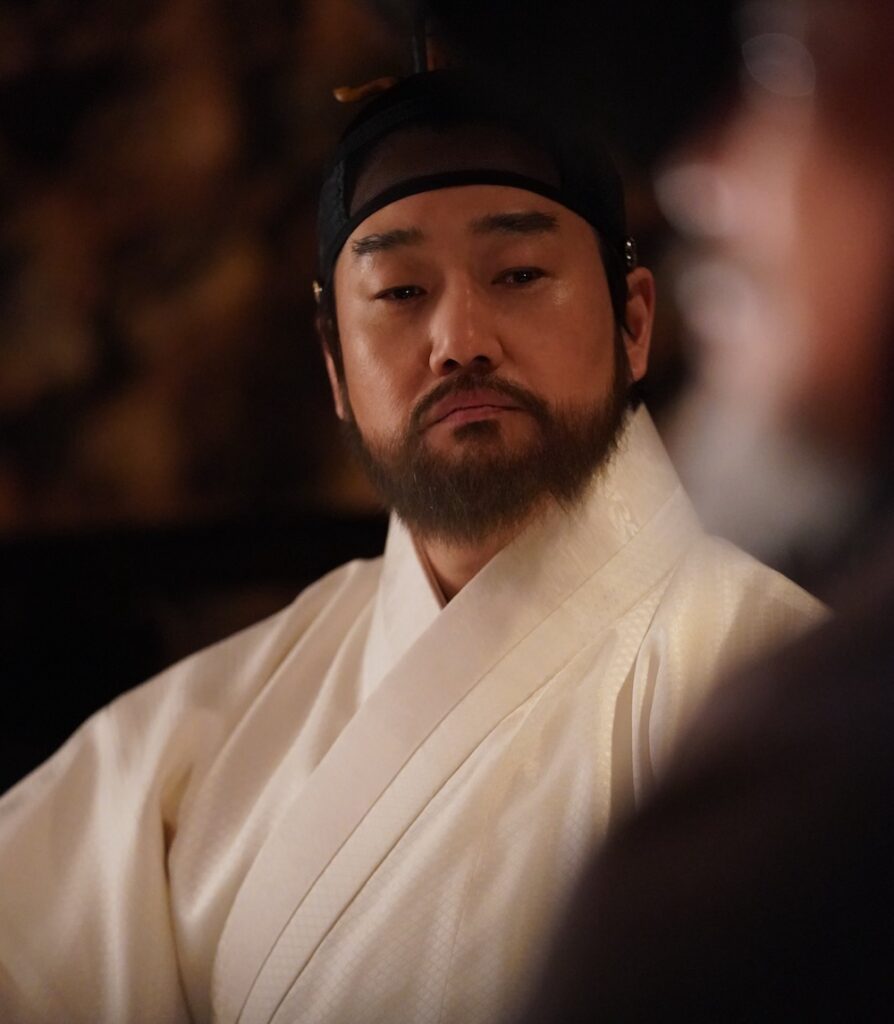
Yoo Ji-tae plays villain Han Myeong-hoe in “The King’s Warden”, Showbox 2026
His story ended as dramatically as it began. Seventeen years after his death, his tomb was opened by royal order, his body exhumed, and his head displayed at a crossroads in Hanyang by his own great grandson.
It is a life that sounds like historical fiction, yet every major episode is documented in the royal annals. More remarkable still is how unlikely that career once seemed.
The Making of a Kingmaker
Han was born in Hanyang in 1415 into a distinguished family. His grandfather, Han Sang-jil, had been one of the founding ministers of the Joseon dynasty, but family prestige brought him little personal success. His parents died while he was still young, leaving him and his younger brother to be raised by relatives.
Like every ambitious scholar of his generation, Han pursued success through the civil service examinations, the only respectable path into government. For nearly twenty years he failed repeatedly. His closest companion during those years was Gwon Ram. The two studied together, traveled together, and watched others advance while they remained on the margins of public life. Eventually Gwon passed the examinations with the highest score in the nation. But Han continued to fail.
Finally, in 1452, at the age of thirty-eight, Han abandoned the examinations and accepted a hereditary appointment as caretaker of Gyeongdeokgung, a minor palace in what is now North Korea. The position carried an official title but little status, amounting to little more than a palace janitor. By every conventional measure, his ambitions had come to nothing.
His fortunes changed because Gwon Ram had not forgotten him. By then Gwon had become a trusted adviser to Prince Suyang, the ambitious second son of Sejong the Great. King Munjong was dying, and the twelve-year-old Danjong was about to inherit the throne. Suyang needed capable men, and Gwon told him that the most brilliant strategist he had ever known was not a celebrated minister but an obscure palace caretaker living in the north.
When Han finally met the prince, he presented a sweeping analysis of the kingdom’s political situation and pledged his loyalty. More importantly, he brought practical preparations. Over years of obscurity, he had quietly cultivated relationships with lower-ranking military officers and also compiled a careful assessment of the royal court, identifying those who could be persuaded, those who posed a threat, and those who would have to be eliminated.
In the autumn of 1453, those preparations paid off. Suyang seized power in a single night, and by dawn Han Myeong-hoe had risen from an overlooked palace caretaker to the second most powerful man in Joseon. It is at this point that The King’s Warden begins.
Power and Consequence
Prince Suyang’s coup transformed the political landscape of Joseon overnight. The morning after the coup, Han had become the kingdom’s de facto ruler, but one problem remained. The young King Danjong was still alive.
For the next four years, Han Myeong-hoe worked to secure the new regime. When plots emerged to restore Danjong, he responded with characteristic efficiency. In 1455, Suyang formally took the throne. Two years later, another conspiracy involving Suyang’s younger brother, Prince Geumseong, convinced the court that the former king could not be allowed to live.
By then Danjong, only sixteen years old, was living in exile at Cheongnyeongpo in the mountains of Yeongwol under the watch of a local official named Um Heung-do, the man masterfully portrayed by Yoo Hae-jin in The King’s Warden. The film begins after the struggle for power had largely culminated, when the political outcome was already decided and only the consequences remained. That decision gives the story its emotional weight. Rather than asking who will win, it asks how the people respond when confronted with extraordinary injustice.
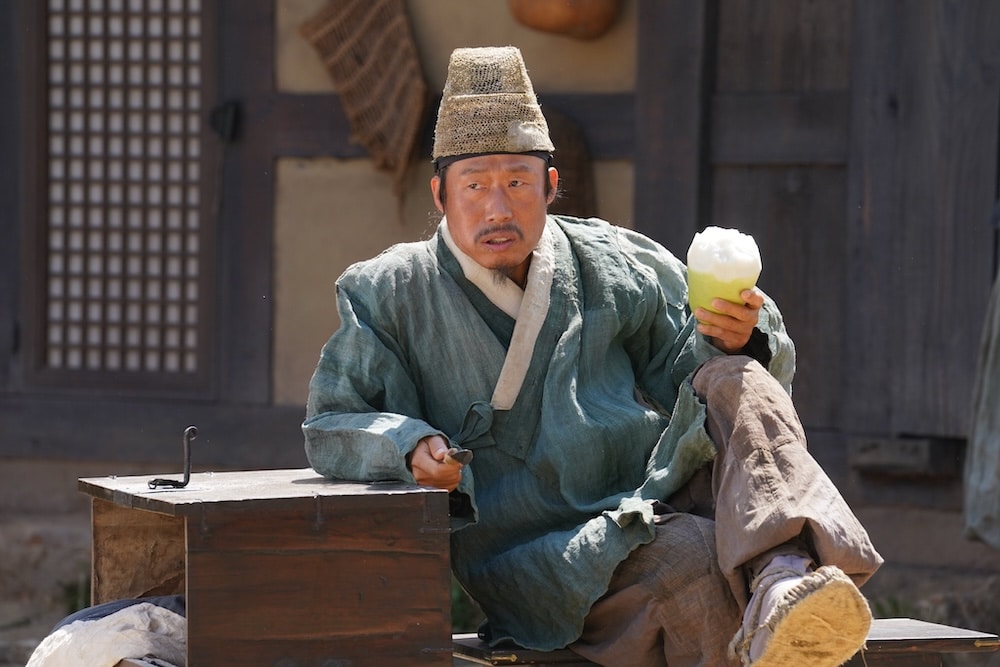
Yoo Hae-jin plays the village chief who is the king’s warden. Showbox 2026
The historical record tells us what happened next. Danjong was executed in 1457, and by royal decree anyone who recovered his body for burial would be put to death. The film imagines the anguish surrounding those events, filling in the gaps that history inevitably leaves behind. Like Amadeus, it is less interested in reconstructing every documented fact and more interested in exploring the emotional truth that facts alone cannot convey.
That approach also shapes its portrayal of Han Myeong-hoe. Yoo Ji-tae never plays him as a one-dimensional villain. His Han is intelligent, composed, and relentlessly practical, qualities that made the historical figure so formidable. He is frightening not because he is consumed by rage, but because he views loyalty, friendship, and even human life as obstacles to be managed in pursuit of political stability. The historical Han proved just as complex.
For the next three decades, Han remained one of the most influential men in Korea. He served as Minister of Personnel, Minister of War, Governor General of the Four Northern Provinces, and three times as Chief State Councillor, the highest civil office in the kingdom. His frontier administration even earned praise from historians who condemned his role in the coup, suggesting that he possessed genuine administrative ability as well as political brilliance.
His influence extended beyond government. Two of Han’s daughters married into the royal family, and one became the mother of King Seongjong. Once again, Han had helped place a king on the throne. This time, however, it was his own grandson.
By the 1470s, Han had largely withdrawn from active politics, although few believed he had surrendered his influence. Along the Han River, he built a pavilion called Apgujeong, where he spent much of his retirement entertaining scholars and officials. The pavilion itself disappeared centuries ago, but its name survives as one of Seoul’s most prestigious neighborhoods. Today, Apgujeong is synonymous with wealth and luxury, perhaps appropriate for what was once home of such a powerful man. Yet legacy, in Han’s case, proved hard to maintain.
The Price of Power
Han died in 1487, seemingly secure in the legacy he had spent a lifetime constructing. History, however, had one final reversal in store.
In 1494, Prince Yeonsan ascended the throne. As he investigated the political intrigues surrounding the death of his mother, Queen Yun, he concluded that Han Myeong-hoe had been among those responsible for her downfall. A decade later, he ordered one of the most extraordinary acts of posthumous punishment in Korean history.
Han’s tomb in Cheongju was opened. His body was exhumed, his head severed, and the remains displayed publicly in Hanyang as a warning to others. The irony was striking. Yeonsan was the son of King Seongjong, Han’s own grandson. The man who had spent his life making kings ultimately suffered humiliation at the hands of his own royal great-grandson.
When Art Meets History
The King’s Warden succeeds not because of the extraordinary series of political events that took place. Instead, it reminds us that history is experienced not only by kings and ministers, but also by ordinary people caught in the wake of their decisions.
That perspective gives the film its emotional power. The broad outlines remain faithful to history, but the conversations, relationships, and quiet moments between its characters belong to the imagination.
History tells us that Danjong was deposed, exiled, and eventually executed. It records the dates, the decrees, and the names of those responsible. What it cannot tell us is what it felt like for a frightened teenager to realize that everyone who remained loyal to him was risking death, or what it meant for a village official to choose conscience over self-preservation.
The film’s emotional climax centers on sangyeo sori, the traditional funeral song sung as the dead are carried to their final resting place. What began centuries ago as a local funeral custom becomes something universal, expressing grief in a way that transcends language and culture. It is one of the most moving scenes I have watched in years.
The historical record adds one final act of quiet courage. Despite Sejo’s decree forbidding anyone from recovering Danjong’s body, Um Heung-do is remembered for ensuring that the young king received a proper burial. More than two centuries later, in 1698, Danjong was restored to the throne in name, reburied with full royal honors, and recognized once again as a rightful king of Joseon. The boy who had died as a disgraced exile was finally given the dignity that politics had denied him.
Leaving the theater in Times Square, I looked around at an audience that most likely had little to no familiarity with Korean history. Many were visibly wiping away tears. They had not come because they knew the story of Danjong or recognized the name Han Myeong-hoe. They came because the film told a deeply human story about loyalty, loss, ambition, and moral courage. For me, that was the film’s greatest achievement.
Like many Koreans, I have known the story of Danjong since childhood. I knew the dates, the names, and the political consequences long before I bought a ticket. What I had never fully considered was the emotional reality behind those facts. Watching The King’s Warden, I found myself thinking less about kings and ministers and more about the ordinary people who lived through those events and the impossible choices they faced.
The best historical films do more than illustrate the past. They encourage us to return to it with fresh eyes. The King’s Warden accomplishes exactly that. It transforms one of Korea’s most familiar historical tragedies into a story that resonates far beyond its own time and place, reminding us that while history records what happened, art helps us understand why it mattered.
The King’s Warden, Streaming Now
In the US: VIKI
In Korea: Apple TV