When we hired a private tour guide in Busan, I had a fairly straightforward agenda: ancient temples, historical landmarks, beautiful landscapes, and a little cultural enlightenment.
Our guide, however, had other ideas.
She was exceptionally professional, knowledgeable, and thoughtful. But as we exchanged itinerary suggestions in advance, I noticed a recurring theme. She kept recommending cafés. Lots of cafés.
We kept steering her toward temples and historical sites. She kept steering us toward coffee and pastries.
At one point, we crossed at least three cafés off her proposed itinerary. After all, we’d traveled halfway around the world to experience Korea’s rich history. Surely we could find a good cup of coffee closer to home? As it turned out, she knew something we didn’t.
Despite our initial resistance, we ended up visiting three cafés in Busan: two with our guide and a third on our own the following morning. And to my surprise, they became some of our most memorable experiences.
Three Cafés, Three Different Experiences
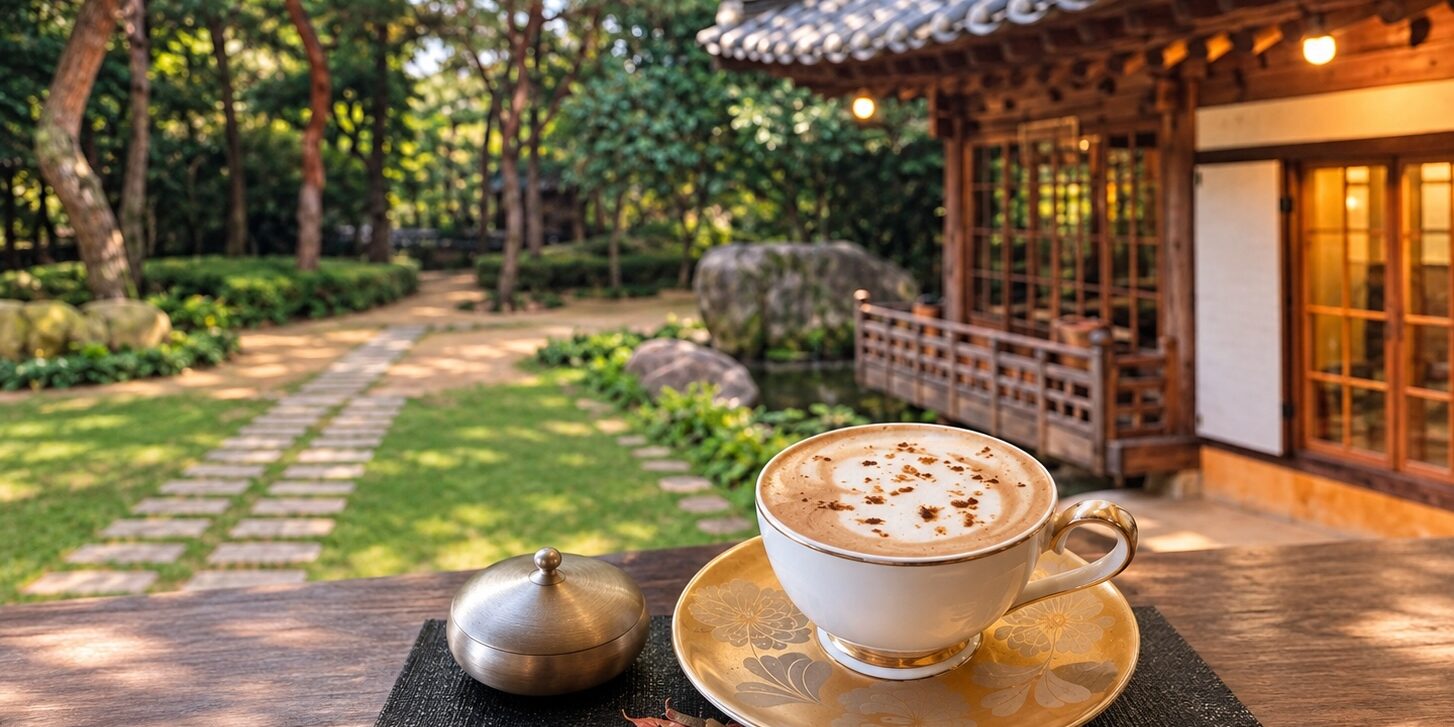
Our first stop was Gallery Yedong, a beautifully renovated traditional Korean hanok. One member of our group had never experienced hanok architecture, so we thought it would be worth a visit.
The renovation was stunning, blending traditional Korean architecture with contemporary design. Our guide shared that her son had actually gotten married there, which made the experience even more special.
It was a wonderful example of how historical architecture can find new life in modern Korea. And being able to enjoy coffee and pastries in such a beautiful setting certainly didn’t hurt.
Our second stop was something entirely different.
ZM-ILLENNIAL, formerly Magnate, is a contemporary café operated by the father of Jimin, a member of the enormously popular K-pop group BTS. It has become something of a pilgrimage destination for BTS fans, known as ARMY.
We happened to be nearby and had heard the café was planning to close, so curiosity got the better of us.
I’m hardly a BTS superfan, but I found the place fascinating. The stylish interior, memorabilia, and devoted fan following made it feel more like a cultural attraction than a coffee shop. It was an interesting glimpse into the remarkable global reach of Korean pop culture.
Our third café experience happened entirely by accident.
The following morning, we needed breakfast before heading to Korean Costco. Yes, even on vacation, Costco somehow finds its way onto the itinerary! ☺️
Our guide suggested Terarosa, a Korean specialty coffee and bakery chain known for its industrial-style interiors and excellent coffee. With locations throughout Korea, it’s clearly not a hidden gem, although it was new to us.
And what a pleasant surprise.
I had one of the best cups of coffee I’ve ever tasted. The pastries were equally delicious, and the atmosphere was far more inviting than anything we would have found at one of the ordinary chains near our hotel.
By our third café, I was beginning to understand why our guide had been so enthusiastic.
Korea’s Remarkable Café Culture
Korea’s café culture isn’t just popular. It’s practically a national pastime.
The country had approximately 45,000 coffee shops in 2018. By 2024, that number had more than doubled to approximately 96,000 in a country of roughly 52 million people. That’s an impressive amount of caffeine.
But the appeal goes well beyond coffee. In Korea’s densely populated cities, where living spaces can be relatively small, cafés serve as extensions of people’s homes. They’re places to socialize, study, work, date, or simply take a break from the pace of daily life.
Part of Korea’s café obsession can be explained by the concept of 소확행 (sohwakhaeng), meaning “small but certain happiness”, the idea of finding joy in life’s simple pleasures. In Korea’s densely populated cities, where many people live in relatively small apartments, cafés offer a welcome escape from cramped living spaces and the pressures of daily life. For the price of a latte and a pastry, you can enjoy a beautifully designed space that feels like an extension of your living room, only with someone else doing the dishes.
Many Korean cafés have also become architectural destinations in their own right. Beautifully restored hanoks, converted factories, elaborate gardens, and spectacular waterfront properties are all part of the experience.
And of course, there’s the Instagram factor. Some cafés are so carefully designed that the surroundings are practically as important as what’s being served.
What struck me, though, was how these spaces encourage people to slow down. Rather than rushing through another attraction, you can sit somewhere beautiful, enjoy an excellent pastry, and simply appreciate your surroundings. Perhaps that’s the real appeal of Korean café culture: a little everyday luxury and a good excuse to slow down.
For someone who tends to approach sightseeing with a rather ambitious itinerary, perhaps there’s a lesson in that.
And Then There’s the Real Estate Question
Of course, my real estate investor instincts couldn’t help noticing something else.
Some of Korea’s enormous, beautifully designed bakery cafés occupy exceptionally valuable properties. Between the land, architecture, and elaborate interiors, I found myself wondering how many cups of coffee one would need to sell to make the economics work.
Interestingly, there may be another explanation in certain cases: inheritance-tax planning.
In January 2026, Korea’s National Tax Service announced an investigation into large bakery cafés suspected of taking advantage of favorable family-business inheritance-tax provisions.
Under certain conditions, qualifying bakery businesses can benefit from substantial inheritance-tax deductions that ordinary coffee shops generally cannot.
The potential savings are remarkable. Korean tax authorities illustrated a hypothetical situation involving land worth approximately $21 million. Under ordinary inheritance rules, the tax bill could approach $9.5 million. But if the land formed part of an eligible family bakery business and all the required operating and succession conditions were met, the inheritance-tax liability could theoretically fall to zero. That’s quite a financial incentive to keep the ovens running.
Of course, this doesn’t mean that every beautiful bakery café is a tax-planning strategy. Most are genuine businesses operating in an increasingly competitive market, and the Korean government has been scrutinizing attempts to misuse these provisions.
Still, it’s an intriguing reminder that sometimes there’s more behind a spectacular café than excellent coffee and good design.
Beyond pretty cafés are world-class bakeries
And the pastries deserve special mention. It turns out Korea hasn’t just perfected the art of designing beautiful cafés; its bakers are now competing with the world’s best. In January 2026, South Korea won the prestigious Bakery World Cup in Paris, beating France itself, along with Japan and the United States. This wasn’t a fluke either; Korea also won in 2016 and finished second in 2024. Korean pastry chefs have been collecting other international honors as well. So perhaps I shouldn’t have been so surprised by the extraordinary pastries at Terarosa. Apparently, Korea has quietly become a world-class baking destination while the rest of us were still talking about kimchi and barbecue.
A Reluctant Café Convert
Looking back, I think our guide understood something about contemporary Korea that I initially overlooked.
We arrived wanting to experience Korea’s past: its temples, traditions, and historical landmarks. She wanted us to experience its present as well.
Gallery Yedong showed us how traditional architecture can be beautifully reimagined. ZM-ILLENNIAL introduced us to the cultural phenomenon of K-pop fandom. And Terarosa reminded us that something as simple as a wonderful cup of coffee can become a memorable travel experience.
Three very different cafés, each offering something unexpected.
I still wouldn’t trade a magnificent Buddhist temple or a breathtaking coastal landscape for just another trendy coffee shop. But I’ve come to appreciate that Korea’s café culture is about much more than coffee. It’s about architecture, creativity, social connection, and the pleasure of slowing down.
And occasionally, it seems, some interesting real estate economics. So the next time a Korean tour guide suggests another café, I probably won’t be quite so quick to cross it off the itinerary.
Although I’d still like to see the temple first!