A karaoke room in Manhattan, a suitcase full of gel sticks, and the surprisingly serious science behind Korea’s thirty-year war on the hangover
Late to the Soju Pre Game Ritual
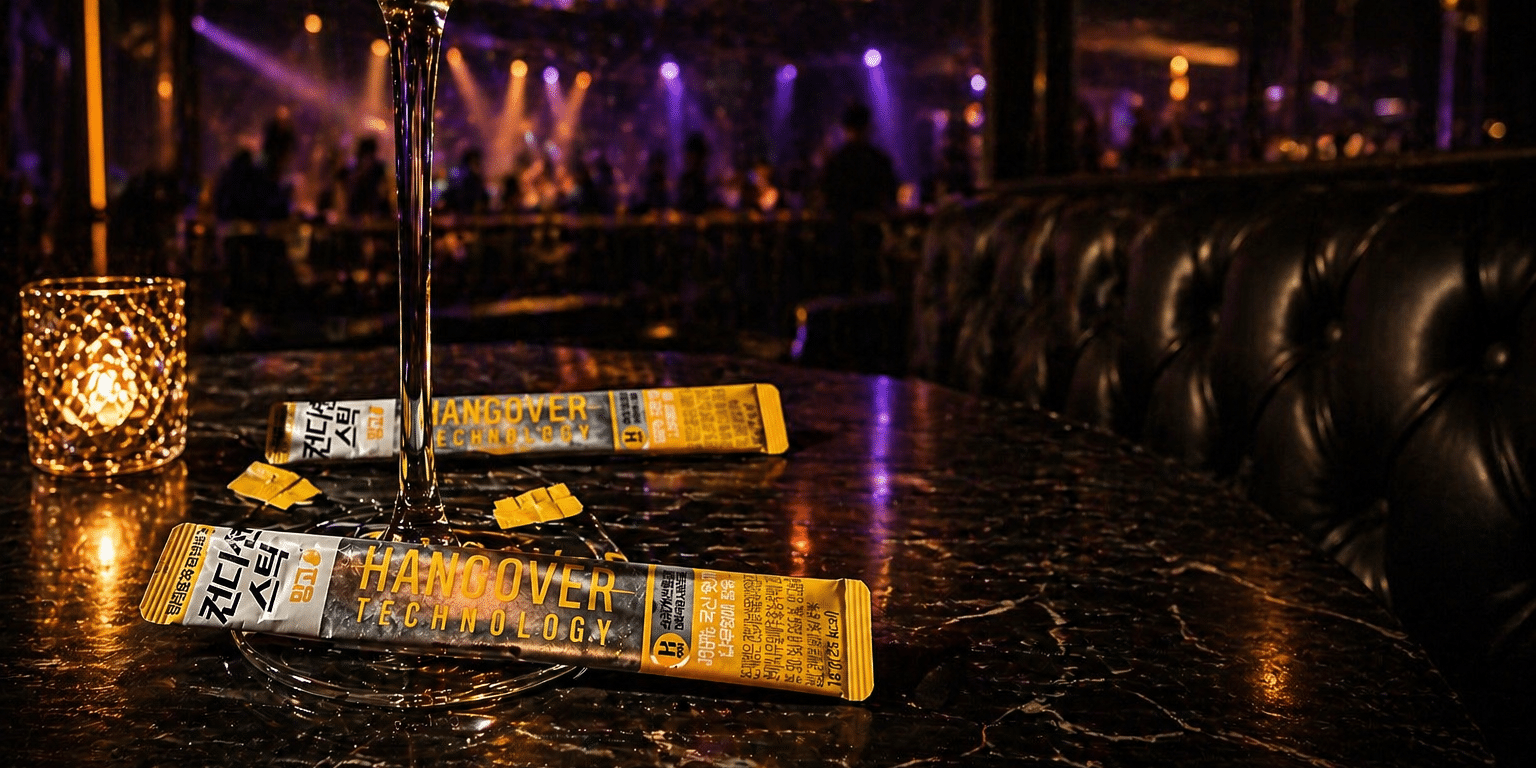
My friends Sue and Sonny had just landed in NY from a trip to Seoul, their suitcases loaded with the usual haul: sheet masks, gochugaru, and boxes of something called Condition Stick. They distributed them at the restaurant table before the cocktails arrived, the way you might pass out gum after a Korean dinner. They told us to tear it open and squeeze contents into mouth. No water needed.
I am Korean, and I am, by any honest measure, a terrible drinker. One glass of wine and my face looks like I’ve been lightly steamed. Two drinks and I’m ready for bed. I normally manage to nurse a cocktail through dinner but on this particular evening, during dinner and karaoke in Koreatown, I drank way more soju than I normally would, slept without the usual fragmented 3 a.m. disruption that alcohol reliably triggers in me, and woke up the next morning with no headache. I am not a person who makes dramatic health claims. But something was different and I started reading the ingredient label.
What I found was that Condition, the brand behind that foil stick, has been Korea’s best-selling hangover remedy since 1992. It holds over fifty percent of the entire Korean hangover beverage market and has been the country’s leading product in this category for more than thirty years. The Stick is its newer, pocketable format, a mango or green apple flavored gel squeezed directly from the packet. A handful of sticks for all your friends fits easily in a purse or jacket pocket.
The Enzyme You Didn’t Know You Were Missing
To understand why it might work requires a short detour into a genetic quirk that a significant portion of East Asians share and that most Western medicine has historically dismissed as a social curiosity. In Korea, the overall prevalence of alcohol flushing has been estimated at about forty percent of the adult population. The familiar redness, the accelerated heartbeat, the nausea that descends after a single drink — this is not sensitivity in any vague sense. The reaction results from an accumulation of acetaldehyde, a metabolic byproduct of alcohol, caused by a deficiency in the enzyme aldehyde dehydrogenase 2, known as ALDH2. The enzyme’s job is to convert toxic acetaldehyde into harmless acetate. When it underperforms, acetaldehyde accumulates. Acetaldehyde is forty times more toxic than alcohol itself and is classified as a Group 1 carcinogen by the International Agency for Research on Cancer. Every Korean who turns red after half a glass of wine is watching their body fail, in real time, to clear a compound that has no business lingering.
The active foundation of Condition Stick is Hovenia dulcis, an Asian raisin tree grown in Korea’s Gangwon Province. Its stalks contain dihydromyricetin, or DHM, and clinical tests have shown DHM helps the body metabolize alcohol more efficiently and supports liver function. Layered onto that base are milk thistle extract, taurine, barley leaf, wolfberry, L-arginine, and a fermented rice germ extract, a formula that reads like a collaboration between a classical Chinese herbalist and a pharmaceutical research team, which is more or less what it is.
A 350-Billion-Won Solution
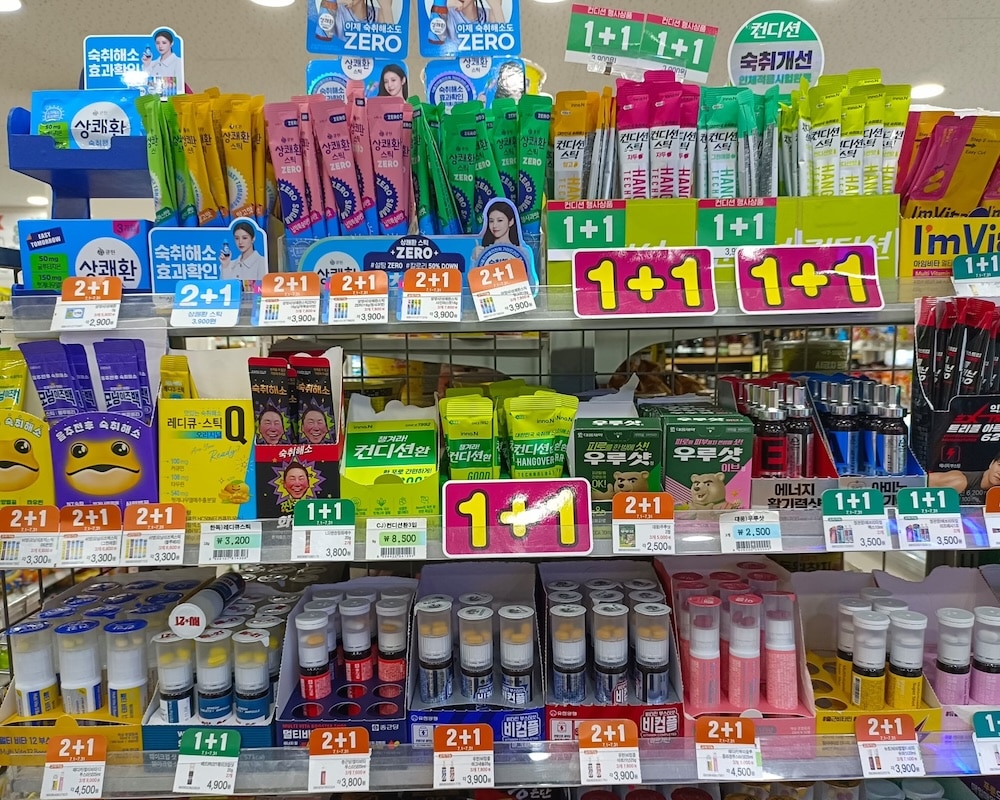
The Korean hangover cure market grew from 224.3 billion won in 2021 to 347.3 billion won in 2023, a number that reflects both the resumption of post-pandemic socializing and the deeper reality that Korean drinking culture has long treated the hangover remedy as a standard-issue consumer product. In certain Seoul offices, buying a round of hangover sticks before a company dinner is an expensable item. Pharmacists in Myeongdong curate personal bundles of their favorites and sell them as tourist souvenirs. A huge variety of sticks can also be found in convenience stores next to the soju.
 What Princeton Rediscovered
What surprised me, reading further, was how the American market arrived at the same molecule from a completely different direction. Cheers, a supplement brand whose founder discovered DHM as a Princeton student after reading a 2012 neuroscience study, is essentially selling the same compound that Korean products have relied on for decades — an extract derived from the Japanese raisin tree, used for centuries in traditional Eastern medicine before Western researchers gave it a clinical framework. Cheers adds L-cysteine to support glutathione production and leans into DHM’s action on the brain’s GABA receptors, the same receptors alcohol binds to, which is a neurological angle that Korean products don’t particularly emphasize. They share a hero ingredient but tell different stories about it: one through the language of traditional herbal medicine, the other through the language of Ivy League biochemistry.
Then there is ZBiotics, which is doing something genuinely different and worth understanding separately. Acetaldehyde forms in two places: the liver and the gut. The liver produces an enzyme that removes it quickly, but the gut does not, so acetaldehyde builds up and lingers. ZBiotics’ engineered probiotic produces the same type of enzyme as the liver, but operates specifically in the gut. This is a real problem that Korean products don’t address. The gut is a meaningful acetaldehyde site, and a genetically engineered bacterium designed to clear it is a legitimate intervention.
Working on the Wrong Floor
But here is the catch that matters for anyone with ALDH2 deficiency: because ZBiotics operates in the gut and not the liver, it explicitly won’t help people whose primary acetaldehyde problem is a liver enzyme mutation. For the roughly forty percent of Koreans carrying that mutation, ZBiotics is working on the secondary problem while leaving the primary one alone. Korean herbal products, by contrast, are oriented specifically toward liver-level support, which is exactly where the deficiency sits. The two products are not in competition so much as they are addressing different floors of the same building. Stacking them, in fact, would be the most comprehensive approach available: one handling gut accumulation, the other targeting liver clearance.
Prove It or Pull It
Korean regulators have recently required companies to scientifically prove their hangover remedy claims or face administrative penalties — a development that will either validate the category or quietly thin its ranks. American supplements, including Cheers and ZBiotics, remain largely unregulated by the FDA in the same way. The science on all of these products, to be direct, is promising but incomplete. Human trials are few. The mechanisms are biologically plausible. And the anecdotal evidence is strong enough that my friends flew back from Seoul with their suitcases full.
Perhaps abstenance is the only foolproof way to protect your body from the harmful side effects of alcohol, but for now, I am so glad to have discovered a product that helps me enjoy my occasional soju fueled karaoke nights. I can’t say for sure whether it was the DHM clearing acetaldehyde from my overworked liver, the milk thistle providing hepatoprotection, the taurine doing something antioxidant and useful, or simply the collective psychological effect of believing I was protected. What I can say is that a culture that has spent thirty years taking this problem seriously, in a country where the genetic stakes are higher than most, has probably learned something that the American wellness industry is only beginning to translate.