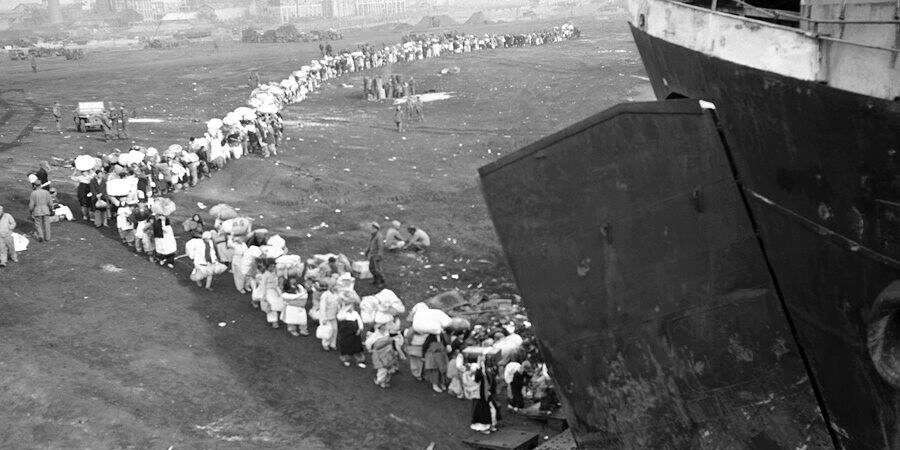
Above: Korean refugees wait to board the SS Meredith Victory.
On a frigid December day in 1950, as communist forces pushed toward the North Korean port of Hungnam, tens of thousands of Korean civilians gathered in desperation while American forces prepared to evacuate. With UN soldiers, weapons, and military equipment to load, they had no room for these refugees. Among those on the scene was Hyun Bong-hak, a young Korean doctor who could not accept that so many would be left behind and face certain death. He appealed again and again to American commanders already under intense pressure and finally persuaded them to take his countrymen to safety. Dr. Hyun’s efforts that day played the pivotal role in successfully evacuating nearly 100,000 civilians. The rescue became one of the defining humanitarian acts of the Korean War and one of the largest US evacuations of civilians in American history.

Refugees on board the USS Meredith Victory. December 1950(PC: Bob Lunney)
A Story So Incredible it Was Captured in a Movie
If this setting sounds familiar, you might have seen the 2014 film Ode to My Father, a film that dramatizes the chaos at the port and the harrowing experiences of separation and survival. The Hungnam evacuation went on to become a foundational story for countless Korean families, including former Korean president Moon Jae-in, who has spoken publicly about his parents having been rescued in this mission. Much less known, however, is the story of Dr. Hyun Bong-hak and how, without his persistence and his ability to speak English, the rescue may never have taken place.
I first met Dr. Hyun in 2003 after I retired from corporate life and joined the Philip Jaisohn Memorial Foundation. He was a board member of the Foundation at the time, and I was so impressed with his story that I insisted on giving him an award at our annual gala, an honor that the kind and unassuming man only reluctantly accepted.
This is the well-documented story of Dr. Hyun and how the courage of one man on a fateful December day saved the lives of 100,000 Korean refugees.

Dr. Hyun Bong-hak, right, accepting the Phillip Jaisohn Award from the author, center, Hong Taek Chung, former chairman of the Phillip Jaisohn Foundation, Photo 2004.
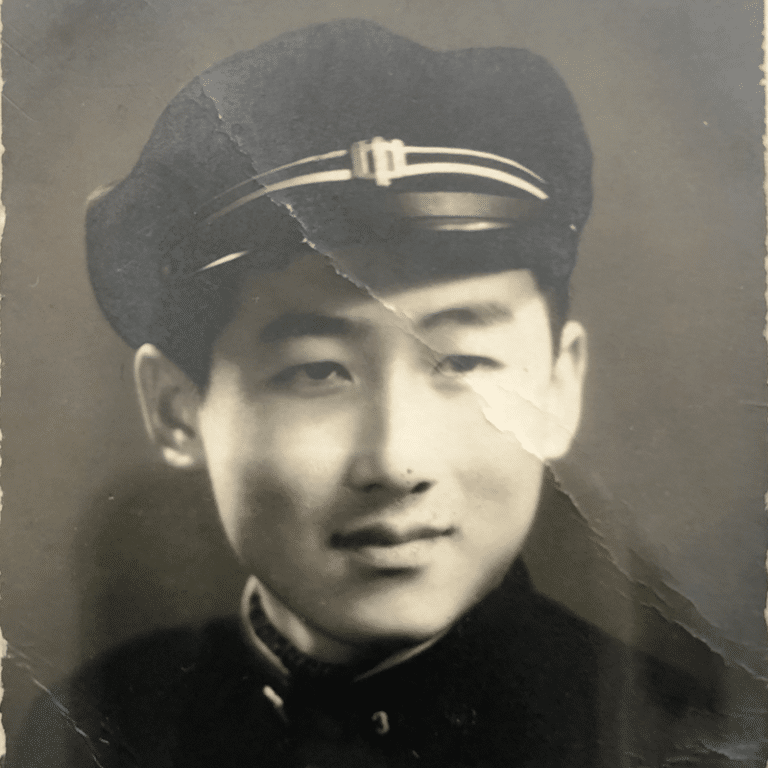
Hyun was born on June 23, 1922, in Hamhung, a city now within North Korea. He grew up in a Christian household that emphasized compassion and service. After graduating from Hamhung High School, he earned his medical degree from Severance Medical College (now Yonsei) in 1944. In 1947 he traveled to the United States on a scholarship to study clinical pathology at the Medical College of Virginia in Richmond, supported by Methodist missionary sponsors who saw promise in the young doctor. By the time he completed his training in 1949 and returned to Korea, the peninsula was only months away from war.

Dr. Hyun Bong-hak circa 1950.
When the conflict erupted in June 1950, Hyun found himself drawn immediately into the crisis. He joined the Republic of Korea Marines as an English-speaking medical officer, treating the wounded while also helping American officers navigate the fast-changing situation. By late 1950, United Nations and South Korean forces were in retreat under intense pressure from Chinese troops, and the port of Hungnam had become the last major exit point for tens of thousands of civilians fleeing south.
Military equipment and personnel were the original priority. The civilians standing at the water’s edge were not included in the plan. Hyun could not accept that. Working closely with Marine Colonel Edward Forney, he repeatedly brought the plight of these families to Major General Edward Almond. Almond was from Virginia and heard a familiar accent from the young doctor who had studied medicine in his home state. Hyun’s steady insistence eventually persuaded Almond to allow civilians aboard the departing ships. That decision changed the course of countless lives.

Col. Edward H. Forney, USMC, the evacuation control officer at Hungnam responsible for loading all refugees onto the ships. (PC: USMC)
One of the vessels involved was the SS Meredith Victory, a small merchant marine cargo ship commanded by Captain Leonard LaRue. Before taking on any civilians, the crew discarded 200 tons of ammunition, 500 shells, and 200 drums of oil, clearing the ship’s holds and decks to make every possible inch available for human passengers. Designed to carry only a dozen people, the ship ultimately took on more than 14,000 refugees, the largest single-ship evacuation in history.
The crossing was cold and dangerous, carried out in mine-ridden waters with no heat, limited supplies, and far more people aboard than the ship had ever been meant to hold. Yet three days later, the Meredith Victory arrived safely in the south without losing a single life. Five babies were born during the journey, a detail that has become one of the most enduring symbols of the evacuation’s improbable success.

NY Times reporting on the evacuation of Hungnam.
After the fighting ended, Hyun returned to the United States to continue his medical training. He completed a residency at Presbyterian Medical Center in Pennsylvania and earned a Doctor of Science from the University of Pennsylvania in 1959. His career in pathology and medical education spanned many decades and included teaching positions at Thomas Jefferson University Hospital and leadership roles in several medical centers. He also became active in the Korean American community, helping to establish cultural and educational organizations and supporting efforts to preserve Korean heritage. He never missed an opportunity to invite Korean international students to his home whenever one needed a place to stay or a warm meal to remind them of home.

Dr. Hyun and his young family at their home in NJ.
Hyun Bong-hak passed away in New Jersey on November 25, 2007, only a few years after I met him. Today, many refer to Dr. Hyun as the Korean version of Oskar Schindler, the German industrialist who saved the lives of more than a thousand Jewish refugees during the Holocaust. There is a statue of Dr. Hyun in front of Severance Health Checkup Center in Seoul that memorializes his deeds that fateful Christmas in 1950.
Dr. Hyun left behind a legacy rooted in compassion and a belief in the dignity of ordinary people. The descendants of those who survived because of the Hungnam evacuation is now estimated to be about a million people and include a past president of Korea. I wish I had known Dr. Hyun longer and could have probed deeper into the heart of the man who met his moment in history with such courage and conviction. Long after I’m gone, I hope the world will continue to tell the story of the young doctor who would not be silenced.

Statue of Dr. Hyun Bong-hak at Yonsei University Severance Building, near Seoul Station.