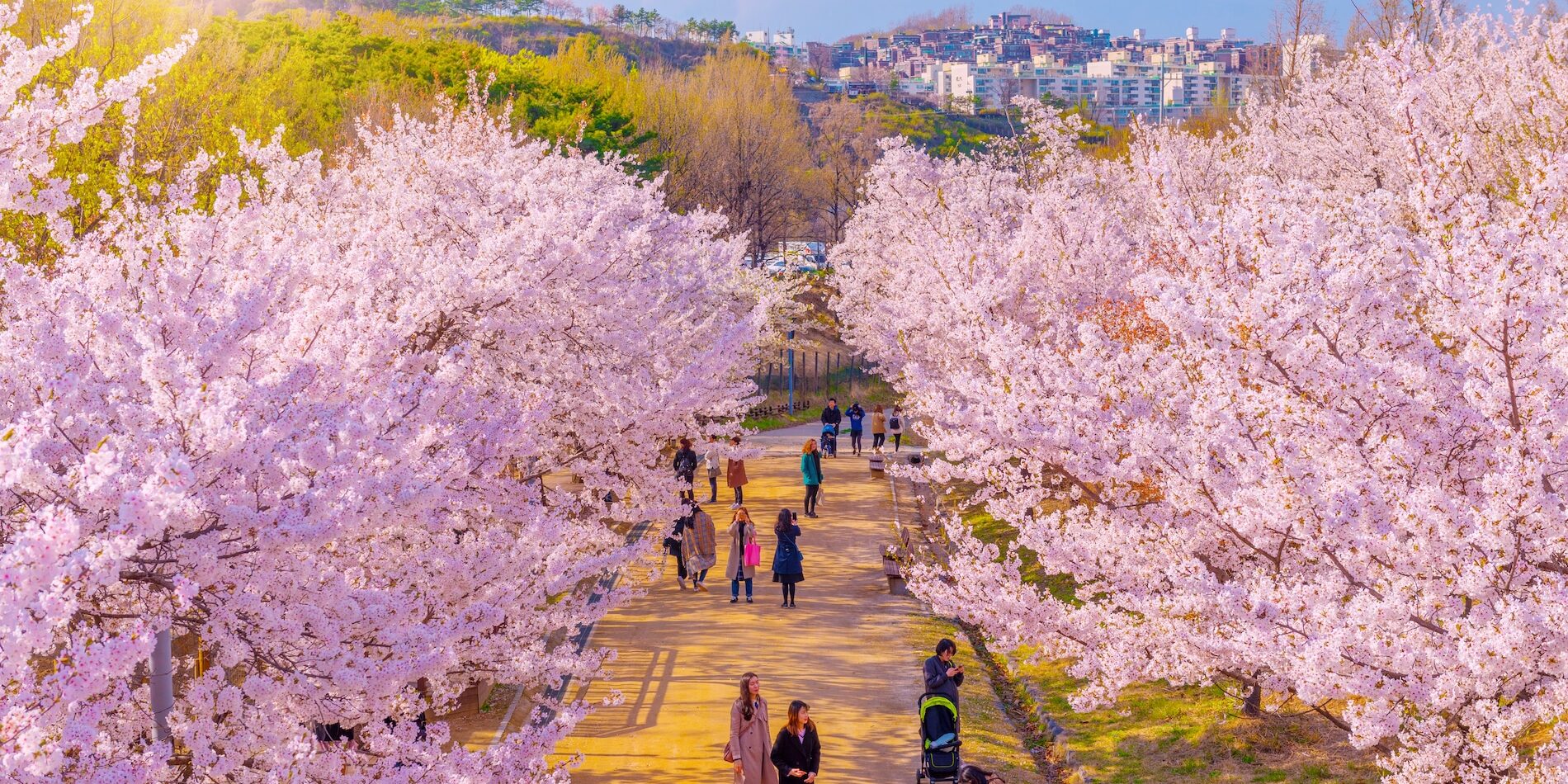
There is a quality to cherry blossom season in Korea that resists being photographed. You can capture a single tree against a palace wall, or the pink tunnel of Gyeonghwa Station in Jinhae, but no image quite holds the feeling of standing under a canopy of petals in a warm afternoon wind, watching them drift down like slow snow. The Koreans have a word for this particular pleasure: 꽃놀이 (kkotnori) — flower play. It is an annual ritual that Koreans look forward to every year.
The 2026 season is already underway. Blossoms are opening in Jeju and Busan this week, tracking two to seven days ahead of the historical average, pushed forward by a warmer-than-usual February and March. If you are planning to go, or simply want to watch from a distance with a better understanding of what is actually happening, this is the guide.
2026 Season Update: The Korea Tourism Organization’s official forecast confirms cherry blossoms will bloom two to seven days earlier than average this year. First blooms are expected in Jeju Island and Busan around March 25, with Seoul following around April 3 and reaching peak bloom around April 10. The window at any given location is roughly one week — plan accordingly.
A Brief, Complicated History
Cherry trees have grown on the Korean peninsula for centuries. The native variety — called the King Cherry (왕벚나무, wang-beotkkot) — grows wild on Jeju Island, covering 235 areas of the Hallasan volcano. DNA analyses by the Korea National Arboretum have confirmed its Korean origin: there are no wild habitats for the King Cherry anywhere in Japan.
That distinction matters more than it might seem, because the other variety most commonly seen across the Korean mainland is the Yoshino cherry tree — and its presence is the direct result of Japanese colonialism. During Japan’s occupation of Korea (1910–1945), the colonial government planted thousands of Yoshino cherry trees throughout the peninsula, including around Seoul’s royal palaces. In his 2020 book Seeds of Control, historian David Fedman documents how this planting was designed to “instill cultural refinement” in the Korean people — part of a broader campaign to assimilate Koreans into Japanese culture that included the suppression of the Korean language, traditional practices, and cultural symbols.
The King Cherry blooms for just three to five days at its peak. Its petals are larger, fluffier, and richer pink than the Yoshino — a dramatic, snowy effect when the wind takes them.
After liberation in 1945, many colonial-era Yoshino trees were removed. The ones that remain have been gradually reclaimed into Korean spring culture over the subsequent decades. Today, cherry blossom season is celebrated with enormous enthusiasm across the country. But the ongoing debate over which tree is truly Korean — and where the King Cherry originated — remains a live point of contention between Korea and Japan. For Koreans, Jeju’s King Cherry trees carry a quiet patriotic significance beyond their beauty.
What is not contested is the emotional power of the season itself. The blossoms have been celebrated in Korean literature, poetry, and painting for generations — a fleeting beauty that arrives abruptly, demands full attention, and is gone within days. That impermanence is part of the point.
The 2026 Bloom Calendar
Korea’s cherry blossom season follows a south-to-north wave, beginning on Jeju Island and moving up through the peninsula over three to four weeks. This staggered timing is a gift for travelers: you can, in theory, follow the bloom northward and catch peak flower across multiple cities in a single extended trip.
Official 2026 Forecast (Source: Korea Tourism Organization / Weather i)
| City | First Bloom | Peak Bloom |
|---|---|---|
| Jeju Island | March 25 | ~April 1 |
| Busan | March 25 | ~April 1 |
| Jeonju | March 28 | ~April 4 |
| Gyeongju | March 28 | ~April 4 |
| Jinhae | March 29 | Festival through April 6 |
| Gangneung | April 1 | ~April 8 |
| Seoul | April 3 | ~April 10 |
| Incheon | April 7 | ~April 14 |
Bloom dates are estimates. Allow ±3 days based on weather. Check VisitKorea’s official forecast at english.visitkorea.or.kr for updates.
Where to Go: The Best Spots
Every city in Korea has its cherry blossom moment. These are the ones that earn their reputations.
01 — Jinhae, South Gyeongsang Province March 29 – April 6 · Festival · Best overall
Consistently called the crown jewel of Korean cherry blossom season, and the label is earned. Over 360,000 trees transform this coastal city into something genuinely disorienting — streets, streams, and hillsides blanketed in soft pink, with the landmark Gyeonghwa Station platform framed so perfectly that it looks art-directed. The best vantage point is Yeojwacheon Stream, where blossoms arch over the water and their reflections double the effect. Go on a weekday. The festival draws enormous crowds on weekends, and the experience is categorically different in the quieter morning hours.
02 — Jeju Island — Jeonnong-ro March 25 – April 1 · King Cherry · Rare native variety
This is where to see the King Cherry — the native Korean variety that blooms larger, fluffier, and richer pink than the Yoshino trees found everywhere else. Jeonnong-ro street is lined with hundreds of trees, some over 100 years old, creating a tunnel of pale pink. Peak bloom lasts only three to five days. The Jeju Sports Complex and Seogwipo’s downtown area are also excellent spots, with open lawns for picnicking beneath the canopy. If your itinerary allows, start in Jeju in late March before the northern wave begins.
03 — Yeouido, Seoul — Han River Boulevard April 6 – 15 · Yeouido Spring Flower Festival · Iconic
The most famous cherry blossom spot in the capital — 1,800 trees along a 5.7-kilometer riverside boulevard that becomes, during the festival, a continuous outdoor celebration of food stalls, performances, and night illuminations. It is also exceptionally crowded. If you go on a weekend afternoon, accept the crowds as part of the experience. Arrive before 9 a.m. on a weekday for something closer to solitude. The night blossom walk, when ambient lighting turns the scene soft and theatrical, is worth staying for.
04 — Seokchon Lake, Seoul March 30 – April 5 · More relaxed than Yeouido
Seokchon Lake is the secret the locals keep until they don’t. The still water perfectly reflects the surrounding blossoms, and the Lotte World Tower rising in the background makes for a characteristically Seoul juxtaposition of ancient-feeling landscape and vertical modernity. The figure-eight walking path that circles both east and west lakes gives you a long, unhurried stroll rather than a single photogenic moment. It tends to peak a few days before Yeouido, meaning you can do both in a single week of careful timing.
05 — Gyeongju, North Gyeongsang Province March 28 – April 5 · History + blossoms
Gyeongju is called “the museum without walls” for good reason — the city is studded with royal burial mounds, ancient stone pagodas, and Silla-era ruins. When cherry blossoms bloom against this backdrop, the combination is something you won’t find anywhere else. The Bomun Lake area and its surrounding blossom street are the main destination, but simply walking the old city is rewarding. An easy day trip from Busan by KTX, or a standalone destination if you have time to slow down.
06 — Kyung Hee University & Seoul Forest April 3 – 12 · For escaping the festival crowds
Kyung Hee University is the most famous campus for blossom viewing in Seoul, with a spectacular Gothic-meets-cherry-blossom aesthetic that photographs magnificently. Seoul Forest, in the trendy Seongsu district, pairs the trees with open lawns, waterways, and freely roaming deer. Seongsu’s cafes launch elaborate spring menus during the season — a good excuse to linger after the walk.
Practical Notes for 2026
Time your visit carefully. Peak bloom at any location lasts roughly seven days. Rain or strong wind can end it in two. Check the KTO forecast and KakaoMap’s real-time blossom tracker in the week before you visit.
Weekday mornings are different places. The same tree surrounded by selfie sticks at noon on a Saturday is genuinely peaceful at 8 a.m. on a Tuesday. The blossoms do not change. The experience does.
Spring menus are everywhere. Cafes launch cherry blossom-themed drinks and desserts across the country. Korean strawberries (딸기) are at peak sweetness in March–April and widely available at street stalls.
The BTS connection this year. BTS’s comeback concert was held at Gwanghwamun on March 21, directly in front of Gyeongbokgung Palace. The palace and its spring blooms are particularly in the cultural conversation this month — worth a visit.
Book Jinhae accommodation early. Jinhae is a small city. Hotels fill months in advance for the festival. Stay in Busan or Changwon and make a day trip if you haven’t booked already.
Follow the bloom northward. With two weeks, you can catch peak bloom in Jeju, then Jinhae, then Gyeongju, then Seoul, then Incheon — following the wave as it moves north. An ideal itinerary for a dedicated spring visit.
After the Petals Fall: What Blooms Next
The end of cherry blossom season is not the end of spring. Korea continues flowering well into June, and the sequence of what comes after 벚꽃 (beotkkot) falls is a quiet pleasure that most visitors miss entirely.
🟡 Forsythia (개나리, Gaenari) — Late March through April The yellow counterpoint to cherry blossom pink. Forsythia blooms slightly before and alongside the cherry trees — Eungbongsan Mountain in Seoul becomes blanketed in it, creating one of the more visually striking hikes of early spring. Bright, almost aggressively yellow, they announce that winter has ended.
🟣 Azaleas (진달래 & 철쭉) — Mid April through Late April Korea has two main azalea varieties. The jindallae (wild azalea) blooms in deep pink-purple in mid-April, covering mountain slopes in carpets of color. The cheoljjuk (royal azalea) follows slightly later with larger flowers and a more intense hue. Hwangmaesan Mountain in South Gyeongsang Province is the most spectacular destination. Wonmisan Mountain near Seoul offers easy access for city visitors.
🌼 Canola Flowers (유채꽃, Yuchae-kkot) — April through May Jeju’s signature spring flower: fields of brilliant yellow canola stretching to the horizon against Hallasan’s volcanic slopes. Noksan-ro Canola Flower Road stretches 10 kilometers and is designated one of the 100 Beautiful Roads of Korea. In Seoul, the Hangang Seoraeseom Canola Festival brings yellow fields to the Han River island from late April.
💜 Wisteria (등나무꽃) — Late April through May Wisteria arrived in Korea’s spring consciousness somewhat recently, propelled by social media’s appetite for purple cascades. The Wisteria Café near Namhansanseong Fortress in Gyeonggi-do — where vines grow over outdoor structures in violet curtains — became a genuine destination. Blooms for two to three weeks starting in late April.
🌷 Tulips — April through May The Taean Tulip Festival at Korea Flower Park in South Chungcheong Province features over 1.5 million tulips in 200 varieties — considered one of the top five tulip festivals in the world. Seoul Forest in Seongsu also maintains a tulip garden that blooms during the same period.
Spring in Korea, seen in full, is a relay of color rather than a single event. The cherry blossoms are the opening act — brilliant, brief, and deservedly famous. But the season extends generously for anyone willing to follow it through.
Bloom dates are estimates based on the Korea Tourism Organization’s official 2026 forecast. Weather can shift peak bloom by several days. For real-time conditions, check KakaoMap’s cherry blossom tracking feature or VisitKorea at english.visitkorea.or.kr.